Pickleball Rules Singles: How One-on-One Play Actually Works

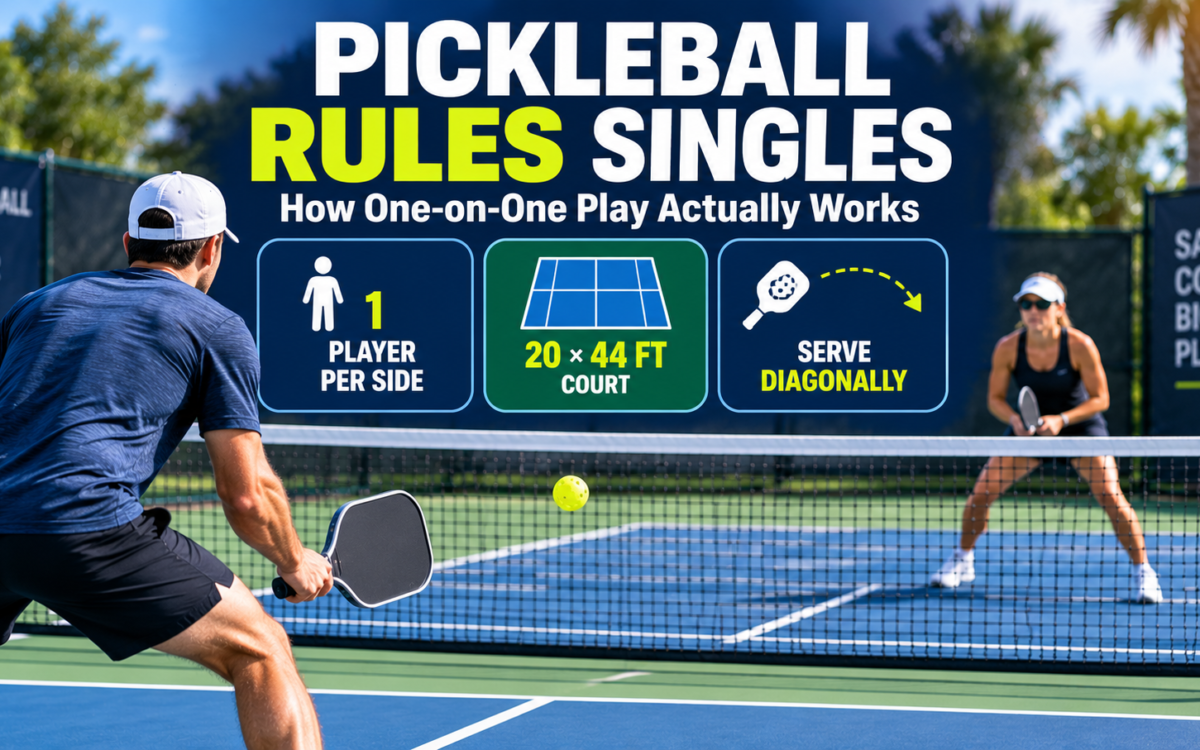
Pickleball rules singles come down to three real differences from doubles: one server per side, a two-number score, and full-court coverage on your own. The kitchen, the two-bounce rule, faults, and scoring to 11 all stay exactly the same.
Pickleball Rules Singles vs. Doubles — Side-by-Side
| Element | Doubles | Singles |
| Players per side | 2 | 1 |
| Servers per side | 2 (both serve before side-out) | 1 |
| First-server exception | Applies | Does not apply |
| Score called as | Three numbers (e.g., 3–2–1) | Two numbers (e.g., 3–2) |
| Court coverage | Shared with a partner | Entire side, solo |
| Court size | 20 ft × 44 ft | 20 ft × 44 ft (identical) |
The coverage change is the one players feel first. You will be running. A lot.
The Court and Kitchen in Singles
Nothing about the court itself shrinks in singles. Same lines, same dimensions, same kitchen — you just lose the partner who used to cover half of it.
Court Dimensions
The court is 20 feet wide and 44 feet long, identical to a doubles court, according to Wikipedia. The non-volley zone (the kitchen) extends 7 feet from the net on each side. Most newer players underestimate how much ground that is until their second or third singles game.
Net Height
The net sits at 36 inches at the sidelines and 34 inches at the center, as reported by USA Pickleball’s official rulebook — the same as a doubles setup.
Serving Rules for Pickleball Singles
Serving is genuinely simpler in singles than doubles. No partner to alternate with, no second server, no tracking who is “first.”
Which Side You Serve From
Your score decides it. Even score (0, 2, 4…) — serve from the right. Odd score (1, 3, 5…) — serve from the left. You keep serving until you lose a rally, then the serve passes to your opponent. Making the even-right, odd-left habit automatic is what stops position faults early on.
How the Serve Works
The serve goes diagonally into the opposite service box, past the kitchen line, underhand, with the paddle head below your wrist at contact. There is no first-server exception in singles — that rule only exists in doubles because teams have two servers.
Foot Faults
Both feet stay behind the baseline, and at least one foot must stay in contact with the ground at the moment of contact. Step on or over the line before the ball is struck and it is a fault. Lose a rally on your own serve and you hand the serve over — no point changes hands.
Scoring in Pickleball Singles
Scoring drops to two numbers in singles, which makes the mental overhead lighter. Your score is called first, then the receiver’s — so you call “1–3,” not the three-number doubles format.
Only the server can score a point. Games are typically played to 11, win by 2. Every time you win a point on your serve, you switch sides of the court — which is exactly why the even-right, odd-left rule keeps your position correct automatically. Players new to singles most often forget the side-switching mid-game, not the scoring format itself.
Rules That Stay the Same as Doubles
If you already know doubles, you already know most of singles.
The Two-Bounce Rule
The serve must bounce once, and the return must bounce once, before either player can volley. No charging the net off your own serve. Experienced doubles players violate this most often when first switching to singles — pure muscle memory.
The Kitchen (Non-Volley Zone)
You still cannot volley while standing in the kitchen, and that includes momentum carrying you in after contact. The zone exists to prevent players from camping at the net and smashing everything — same as doubles.
Line Calls and Faults
You call the lines on your side. On the line is in; clearly out is out. Common faults match doubles exactly: serving out of bounds or into the net, volleying in the kitchen, double bounces, and hitting the ball before it crosses the net.
Skinny Singles — The Practice Variant
Skinny singles uses one player per side but restricts play to half the court — and which half shifts based on your score. It is primarily a practice format used to sharpen accuracy and footwork rather than a separate ruleset. Think of it as a self-imposed constraint on standard singles to force better shot placement.
Conclusion
Pickleball rules singles differ from doubles in only three ways: one server per side, a two-number score, and full-court coverage alone. Everything else — the kitchen, the two-bounce rule, faults, and scoring to 11 — carries over unchanged.
FAQs
Do you serve twice in pickleball singles?
No. Each player gets one serve per turn. If you fault or lose the rally, the serve passes straight to your opponent. That is different from doubles, where both partners serve before a side-out occurs.
Is singles pickleball harder than doubles?
It is generally more physically demanding. With no partner, you cover the whole court yourself — more running, faster repositioning, and quicker reactions. Most doubles players find the footwork the toughest adjustment.
What is the two-bounce rule in singles?
Both the serve and the return must each bounce once before either player can volley. This applies exactly as it does in doubles and stops either player from rushing the net too early.
How do I know which side to serve from in singles?
Check your score. Even (0, 2, 4…), serve from the right. Odd (1, 3, 5…), serve from the left. Since you switch sides after each point you win on serve, this keeps your position correct automatically.
Can I use doubles rules for singles?
Mostly, yes. The main changes are one server per side instead of two, and a two-number score instead of three. Strategy shifts too, since you cover the entire court alone.

James Carter
ContributorMore from More Sports
How Many Players on a Hockey Team? Roster and Ice Numbers Explained
A hockey team normally has six players on the ice at one time: five skaters and one goaltender. In the…
How Long Is a Hockey Game? Periods, Breaks and Overtime
A standard ice hockey game has 60 minutes of regulation playing time, divided into three 20-minute periods. In real time,…
The Complete Guide to What to Wear for Pickleball
If you’re wondering what to wear to play pickleball, the short answer is: a moisture-wicking top, athletic shorts or leggings,…