Pickleball Levels Explained: 1.0 to 5.5+ Skill Guide

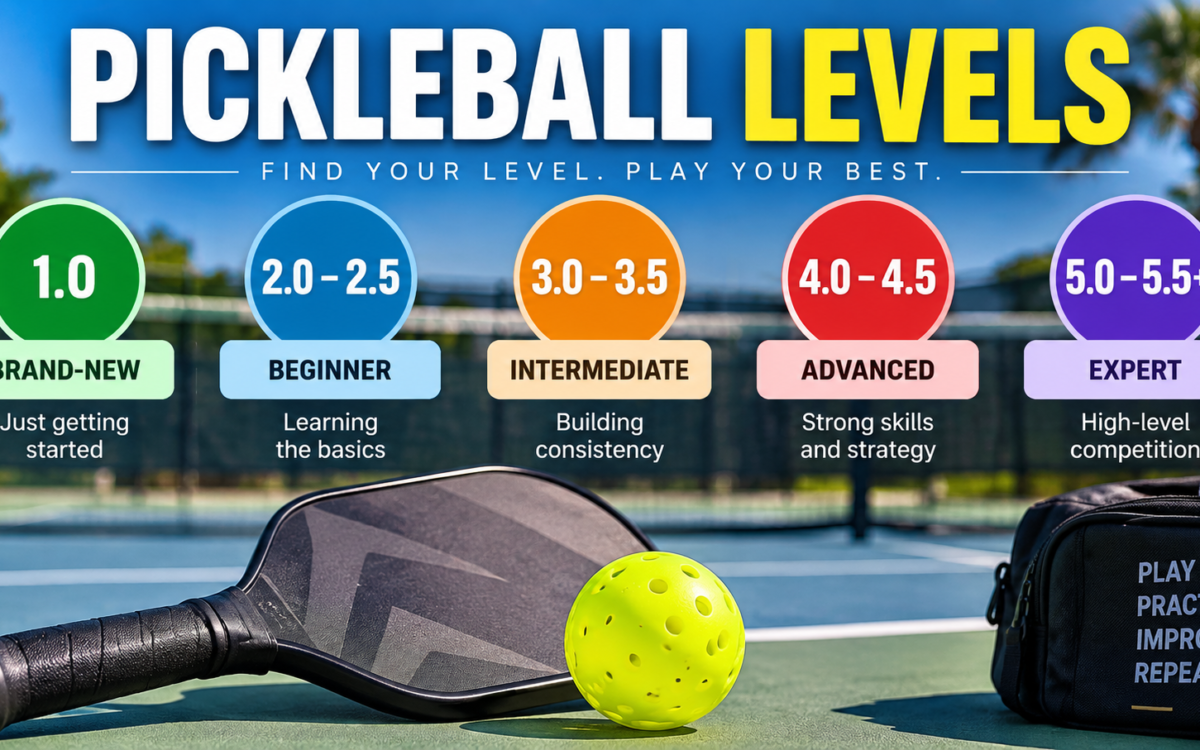
Pickleball levels run from 1.0 for brand-new players to 5.5+ for tournament-caliber competitors, based on shot consistency, court positioning, and strategy rather than raw power. USA Pickleball, the sport’s national governing body, published its first standardized skill level framework in 2005, and that scale still anchors how most clubs, leagues, and self-assessment charts group players today.
The number alone does not tell the full story. Two players can hit equally hard and still sit at different levels, because one controls placement, avoids unforced errors, or reads doubles positioning better than the other.
What Pickleball Levels Measure
USA Pickleball’s framework groups players into six broad bands, judged on shot execution, consistency, court awareness, and strategy rather than match results:
| Level | General Ability | What Stands Out |
| 1.0 | Brand-new player | Learning rules, scoring, and basic strokes |
| 2.0–2.5 | Beginner | Short rallies, developing serve and dink control |
| 3.0–3.5 | Developing to intermediate | Better shot control, third-shot drops, basic strategy |
| 4.0–4.5 | Advanced intermediate to advanced | Consistent placement, spin, and tactical play |
| 5.0–5.5+ | Expert | Full shot range, adaptive strategy, few unforced errors |
USA Pickleball’s official Player Skill Rating Definitions break each level down further by forehand, backhand, serve/return, dink, third shot, volley, and strategy, so a player can be strong in one category and still lag in another.
Level 1.0: Brand-New Player
A 1.0 player has little or no experience and is still learning how the game works rather than refining technique. USA Pickleball describes this stage as leaning heavily on instruction and simple rules while getting used to the court, scoring, and paddle.
Typical focus areas at 1.0 include:
- Rules, scoring, and the non-volley zone
- Basic forehand and backhand strokes
- Serving into the correct service court
- Keeping a rally going for a few shots
Most players move through 1.0 quickly, often within their first few sessions.
Levels 2.0 and 2.5: Beginner
Players in this range understand the basic game but still work on consistency. At 2.0, strokes, serves, and court positioning are still developing, and directional control is limited. By 2.5, USA Pickleball notes that a player has enough experience to sustain a short rally against an opponent of similar ability and keep score reliably.
Common traits in this range:
- Inconsistent serve and return depth
- Limited backhand control, sometimes avoided
- Basic dink rallies with little intentional placement
- Frequent unforced errors on routine shots
Keeping more balls in play, rather than hitting harder, drives most of the improvement at this stage.
Levels 3.0 and 3.5: Developing to Intermediate
At 3.0, players can put serves and returns in play at a medium pace with only moderate direction and depth, and dink rallies start to hold up. Third-shot drops appear, even if they fail often, and games start to look less like paddle-ball and more like pickleball.
At 3.5, control improves noticeably. Players vary serve and return depth, mix soft and power shots, and start reading which side of an opponent is weaker. A typical 3.5 player also:
- Blocks or resets faster volleys instead of just reacting
- Moves with a doubles partner as a unit
- Uses stacking when it fits the matchup
- Chooses between a drop and a drive with more intent
Decision-making, more than raw consistency, tends to separate a 3.0 player from a 3.5 player.
Levels 4.0 and 4.5: Advanced Intermediate to Advanced
A 4.0 player controls depth, pace, spin, and placement on purpose rather than by accident. USA Pickleball’s skill matrix describes 4.0 forehands as consistently landing with depth and control, while shot selection and timing are still being refined. Players at this level handle third-shot strategy, blocks, resets, overheads, and controlled volleys with real consistency near the non-volley zone.
A 4.5 player goes further by creating offense instead of only reacting to it. Dinks are used to move opponents out of position, third-shot choices become purposeful, and defensive rallies can turn into attacks. Poaching, stacking, ATPs (around-the-post shots), and counterattacks become regular parts of match strategy.
Levels 5.0 and 5.5+: Expert
A 5.0 player has a complete game: touch, spin, pace, placement, drops, drives, volleys, and resets from almost any court position. Pattern recognition speeds up, adjustments to a specific opponent happen mid-match, and unforced errors become rare.
USA Pickleball places 5.0 through 5.5+ in its top skill group. A 5.5+ player is described as a top-caliber competitor whose tournament results demonstrate the ability to perform consistently at a high level, on par with advanced amateur or professional play.
Pickleball Skill Levels vs. DUPR Ratings
Pickleball skill levels and DUPR ratings measure related but different things. USA Pickleball’s skill levels are self-assessed descriptions of technique and strategy. DUPR (Dynamic Universal Pickleball Rating) instead calculates a number from actual match results, and as of December 2025 it serves as USA Pickleball’s official exclusive rating system for its Golden Ticket qualifiers and National Championships.
Key differences worth knowing:
- Scale: DUPR runs from 2.000 to 8.000, with new players starting as NR (Not Rated) until they log a verified match.
- Speed: A single verified match is enough for an initial DUPR rating, though the algorithm needs roughly 10 to 20 matches before the number becomes reliable.
- Scope: DUPR tracks singles and doubles separately, and it factors in performance against expectation, match type, and recency rather than a fixed win-loss tally.
- Adoption: DUPR reports more than 2 million rated players worldwide, and top pros such as Ben Johns carry ratings above 7.0.
A self-assessed skill level is a useful starting point for finding balanced games. A DUPR rating gives competitive players a way to track real progress over time and matters more once tournament or league play is involved.
How to Find Your Pickleball Level
Judge your level by what you can execute consistently during real games, not what you can occasionally pull off in practice. Work through these areas honestly:
- Serve and return consistency
- Forehand and backhand control
- Dink accuracy and patience
- Third-shot drops and drives
- Volleys and resets under pressure
- Court positioning and movement
- Shot selection and decision-making
- Rate of unforced errors
- Doubles teamwork and communication
USA Pickleball also publishes a player skill-level self-assessment that walks through each of these categories level by level, which is a faster way to land on an honest starting number than guessing from a single strong session.
Pickleball Levels FAQ
What level is a beginner in pickleball?
A beginner generally falls between 1.0 and 2.5. Players at this stage are learning rules, basic strokes, positioning, scoring, and how to keep a rally going.
Is a 3.0 pickleball player good?
A 3.0 player has moved past the basic beginner stage. They keep serves and returns in play at a medium pace, hold up in dink rallies, and are starting to use third-shot strategy with real intent.
What is considered intermediate pickleball?
USA Pickleball’s skill matrix commonly places 3.5 as the intermediate range. Players here show better shot control, stronger doubles teamwork, and a growing ability to mix soft and power shots on purpose.
What is the highest pickleball level?
USA Pickleball’s skill framework tops out at 5.5+, representing top-caliber players who perform consistently at a high competitive level. Match-based systems like DUPR use a different numerical scale that runs up to 8.000.
Do I need a DUPR rating to play pickleball?
No. Many clubs and casual sessions run entirely on self-assessed skill levels. DUPR or another verified rating typically matters once you enter leagues or sanctioned tournaments that use it for bracket placement.
Conclusion
Understanding pickleball levels makes it far easier to find balanced games and measure real improvement over time. Rather than fixating on a single number, track consistency, placement, positioning, and decision-making as you move from a 1.0 beginner toward advanced and expert play.

Ava Sinclair
Lead Analyst, ChessAva builds GameQuants' engine-evaluation and rating-system models and leads data-quality review across the desk.
More from More Sports
How Many Players on a Hockey Team? Roster and Ice Numbers Explained
A hockey team normally has six players on the ice at one time: five skaters and one goaltender. In the…
How Long Is a Hockey Game? Periods, Breaks and Overtime
A standard ice hockey game has 60 minutes of regulation playing time, divided into three 20-minute periods. In real time,…
The Complete Guide to What to Wear for Pickleball
If you’re wondering what to wear to play pickleball, the short answer is: a moisture-wicking top, athletic shorts or leggings,…