How Many Halves in Soccer? Match Length Explained

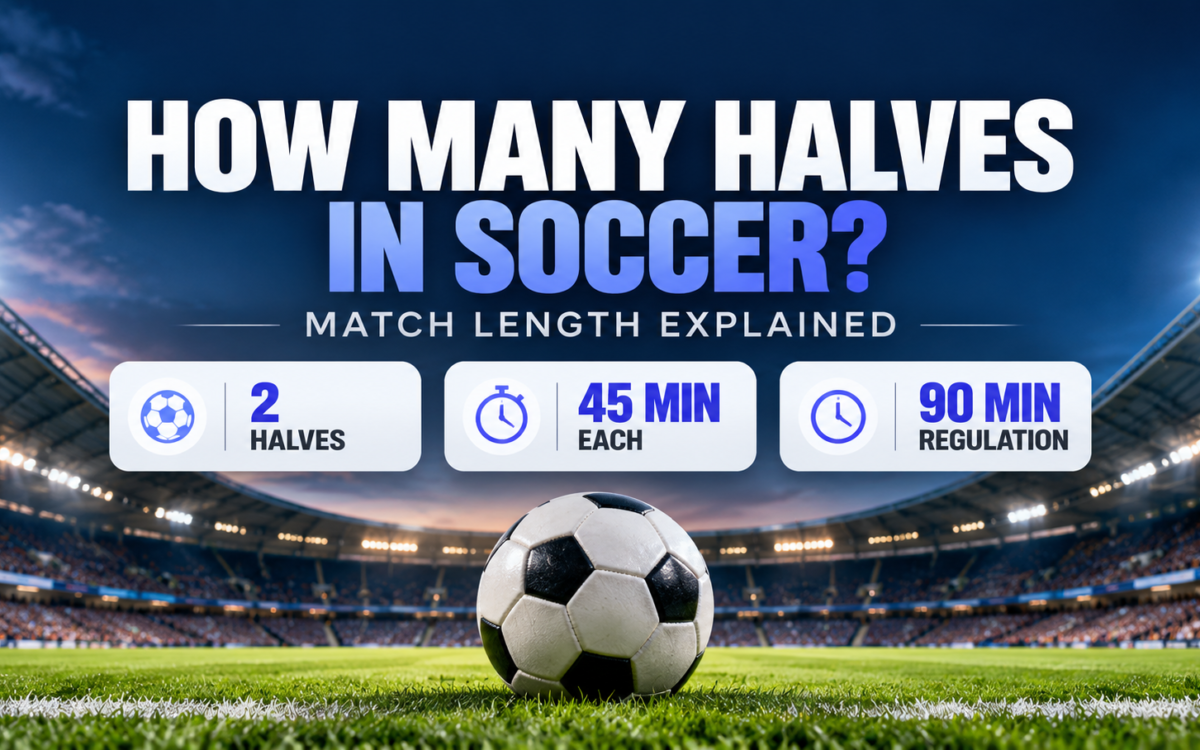
Soccer has two halves in a standard match. Each half lasts 45 minutes, giving the game 90 minutes of regulation playing time. The International Football Association Board (IFAB), which maintains the Laws of the Game, states that a match consists of two equal 45-minute halves, although some competitions may use shorter periods.
How many halves in soccer?
There are two halves in soccer. In a standard adult match, the first half lasts 45 minutes and the second half lasts another 45 minutes, according to Wikipedia.
That gives a normal match this basic structure:
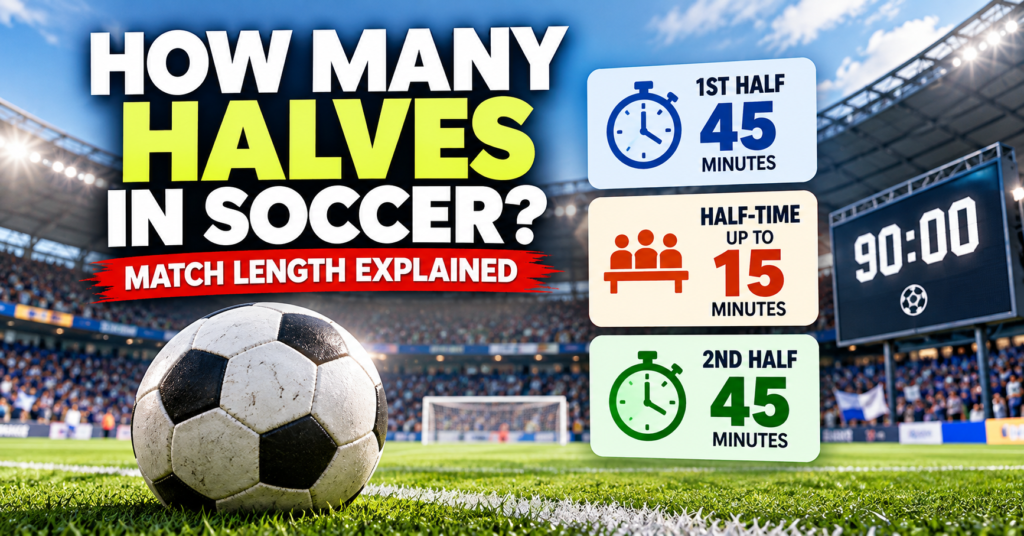
- First half: 45 minutes
- Half-time break: up to 15 minutes
- Second half: 45 minutes
- Regulation playing time: 90 minutes
IFAB Law 7 sets these periods as two equal halves of 45 minutes. A shorter match can be used if it is permitted by the competition rules and agreed before kickoff.
How long is halftime?
The half-time interval can last up to 15 minutes under the Laws of the Game. The exact length is set by the competition, and it can only be changed with the referee’s permission.
During halftime, players typically leave the field, receive instructions from coaches, drink fluids, and prepare for the second half.
After the interval, the teams switch ends. The team that chose which goal to attack in the first half takes the kickoff to begin the second half under IFAB’s kickoff procedure.
Does stoppage time add another half?
No. Stoppage time does not create another half. It is extra time added to the end of the first or second half to compensate for playing time that was lost.
A referee may allow additional time for delays involving:
- Substitutions
- Injuries and player treatment
- Time wasting
- Disciplinary sanctions
- Drinks or cooling breaks
- VAR checks and reviews
- Goal celebrations
- Other significant delays
The fourth official indicates the minimum amount of added time, but the referee can increase it if more delays occur.
For example, a first half could last 45 minutes plus four minutes of stoppage time. It is still the first half, not a separate period.
What happens after two halves?
Many league matches simply end after the second half. If the score is tied, the result can remain a draw depending on the competition.
Some knockout matches must produce a winner. In those competitions, the rules may call for extra time or a penalty shootout.
Traditional extra time consists of two additional periods, usually 15 minutes each, as reported by The Guardian.
Extra time should not be confused with stoppage time:
| Term | When it happens | Typical length | Purpose |
| Stoppage time | End of each regular half | Varies | Replaces time lost during play |
| Extra time | After regulation in certain tied knockout matches | 30 minutes | Helps determine a winner |
| Penalty shootout | After a tie where competition rules require it | Varies | Determines the winning team |
Some competitions skip extra time entirely and go directly to penalties.
Do youth soccer games have two halves?
Many youth soccer games also use two halves, but the length of each half can be shorter than 45 minutes.
US Youth Soccer rules provide examples of age-based match lengths. Its published playing rules list two 45-minute halves for certain older youth age groups, two 40-minute halves for U15 and U16, two 35-minute halves for U13 and U14, and two 30-minute halves for U11 and U12. Younger formats can use still shorter periods or quarters.
This means the answer to how many halves are played is usually two, but the number of minutes in each half may depend on age and competition rules.
Why does soccer use two halves?
Splitting the match into two periods gives both teams the chance to attack each end of the field. IFAB requires teams to change ends for the second half.
The halftime interval also provides a scheduled break between the two periods. Because playing conditions such as wind, sunlight, and field conditions can differ from one end of the pitch to the other, switching ends helps balance those conditions across the match.
FAQs
Is soccer played in halves or quarters?
Soccer is normally played in two halves, not four quarters. A standard adult match has two 45-minute halves. Some young children’s formats can use quarters under modified competition rules.
How many minutes are in each soccer half?
A standard soccer half lasts 45 minutes. Referees can add stoppage time at the end to make up for delays that occurred during the half.
Is there a break between soccer halves?
Yes. Players receive a half-time interval of no more than 15 minutes under IFAB Law 7. Competition rules determine the exact length.
Does extra time count as a third half?
No. Extra time does not count as a third half. It is a separate tie-breaking phase that can contain two additional periods when the competition requires a winner.
Conclusion
So, how many halves in soccer? A standard match has two 45-minute halves for 90 minutes of regulation play. Stoppage time may extend either half, while certain knockout games can continue with extra time or penalties.

James Carter
ContributorMore from Soccer

What Is a Striker in Soccer? Role and Skills Explained
A striker in soccer is an attacking player whose main job is to score goals. Strikers usually play closest to…

When Is Soccer Season in High School? 2026–27 Guide
If you are wondering when is soccer season in high school, the answer depends on your state. High school soccer…
What Size Soccer Ball for 5 Year Old? Size Guide for Parents
If you’re wondering what size soccer ball for 5 year old players is right, choose a Size 3 soccer ball.…