What Is a Striker in Soccer? Role and Skills Explained

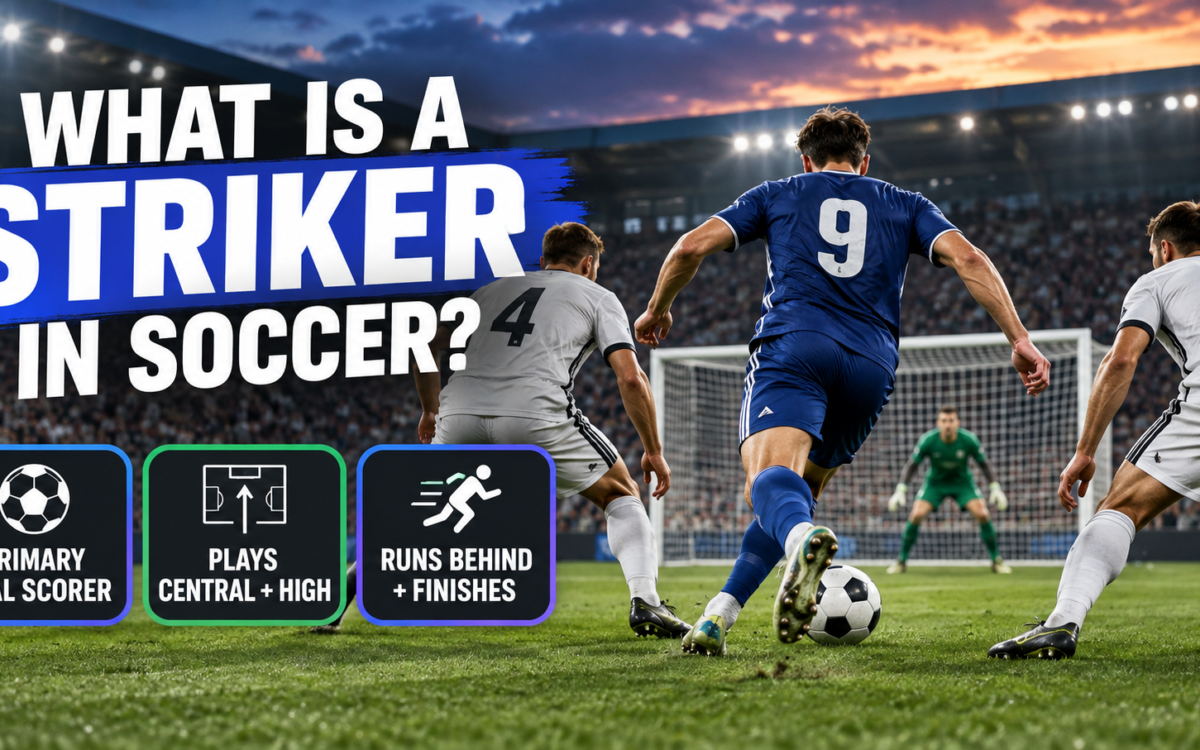
A striker in soccer is an attacking player whose main job is to score goals. Strikers usually play closest to the opponent’s goal, making runs behind defenders, receiving passes in dangerous areas, and finishing scoring chances.
The position is often associated with the number 9 shirt, according to Wikipedia, although modern strikers can play in several different ways depending on a team’s formation and tactics.
What is a striker in soccer?
A striker in soccer is a forward who normally operates through the central attacking areas of the field. Their primary responsibility is to create and convert goal-scoring opportunities.
A striker commonly plays near the opposing center-backs and tries to find space between or behind them. When teammates have possession, the striker may move toward the ball to receive a pass or make a run toward goal.
The role is tactical rather than a position specifically required by the Laws of the Game. Teams are free to organize their outfield players into different formations and roles.
What does a striker do?
Scoring goals is the striker’s most visible responsibility, but the position involves much more than shooting.
A striker may need to:
- Make runs behind the defensive line
- Find space inside the penalty area
- Finish chances with either foot
- Score headers from crosses
- Hold the ball while teammates move forward
- Link passes with midfielders and wingers
- Press defenders when the opponent has possession
- Create space for other attackers
Movement is especially important. A striker who constantly changes position can make it difficult for center-backs to decide whether to follow them or protect the space behind the defense.
Where does a striker play?
A striker generally plays in the central attacking part of the field, ahead of the midfield and close to the opposition’s defensive line.
For example, in a 4-2-3-1 formation, one striker usually plays at the top of the formation. In a 4-4-2, two forwards may play together.
The striker does not have to remain in the middle. Modern center-forwards can combine scoring with movement, link-up play, and runs into different attacking areas, as reported by The Guardian.
The exact positioning depends on the player’s abilities and the team’s tactical system.
Types of soccer strikers
Not every striker performs the position in the same way. Coaches can use several styles depending on how they want their team to attack.
Centre-forward
A centre-forward usually occupies central positions near the opposing center-backs. The player may combine finishing with holding up the ball and bringing teammates into attacks.
The terms “centre-forward” and “striker” are closely connected in modern soccer, although their exact meaning can depend on the tactical system being used.
Target striker
A target striker provides a direct option for passes, crosses, and long balls.
These players are often strong at protecting the ball and competing against defenders. They can receive the ball with their back to goal before passing to an advancing teammate.
Second striker
A second striker normally operates around another central forward rather than staying on the defensive line at all times.
They may drop into deeper spaces, receive the ball between midfield and defense, and then join attacks near the penalty area.
Striker vs forward
A striker is a type of forward, but not every forward is necessarily a striker.
“Forward” is the broader positional category for attacking players. A striker usually refers more specifically to a central attacker whose responsibilities place a strong emphasis on scoring.
| Striker | Forward |
| Usually plays centrally | Can play centrally or wide |
| Main focus is often scoring | May score, create, or both |
| Often plays near center-backs | Covers several attacking roles |
| Commonly associated with No. 9 | Can include strikers and other attackers |
The terminology can vary between coaches, clubs, and tactical systems.
What skills do strikers need?
Good strikers combine technical ability with movement and decision-making.
Important striker skills include:
- Finishing: Converting opportunities accurately and quickly.
- Movement: Escaping defenders and finding open space.
- First touch: Controlling passes before defenders can react.
- Positioning: Anticipating where crosses, rebounds, and passes will arrive.
- Speed: Breaking into space behind defenders.
- Strength: Protecting the ball under pressure.
- Heading: Finishing crosses and competing for aerial passes.
- Composure: Making good decisions when close to goal.
A striker also needs a strong understanding of offside. Simply standing in an offside position is not automatically an offense, but a player can be penalized after becoming involved in active play.
FAQs
Is a striker the same as a forward?
No. A striker is generally a specific type of forward who plays centrally and focuses heavily on scoring goals, while “forward” can describe several attacking positions.
What number does a striker wear?
A striker traditionally wears number 9, but there is no rule requiring it. Players can wear other permitted squad numbers while performing the same role.
Can a soccer team have two strikers?
Yes. A team can play with two strikers, particularly in formations such as a 4-4-2. Other formations may use one central striker supported by attacking midfielders or wide forwards.
Does a striker have to score goals?
Scoring is usually a striker’s main responsibility, but effective strikers also create space, connect attacks, press defenders, and provide assists. Their contribution can therefore extend beyond their goal total.
Conclusion
Understanding what is a striker in soccer starts with one main idea: the striker leads the attack and looks to score. Great strikers also use movement, positioning, passing, strength, and awareness to make the entire attack more effective.

James Carter
ContributorMore from Soccer

When Is Soccer Season in High School? 2026–27 Guide
If you are wondering when is soccer season in high school, the answer depends on your state. High school soccer…
What Size Soccer Ball for 5 Year Old? Size Guide for Parents
If you’re wondering what size soccer ball for 5 year old players is right, choose a Size 3 soccer ball.…

What Size Soccer Ball for 10 Year Old? Size Guide
If you are wondering what size soccer ball for 10 year old players is right, choose a Size 4 soccer…