Drop Coverage Basketball: How the Pick-and-Roll Defense Works

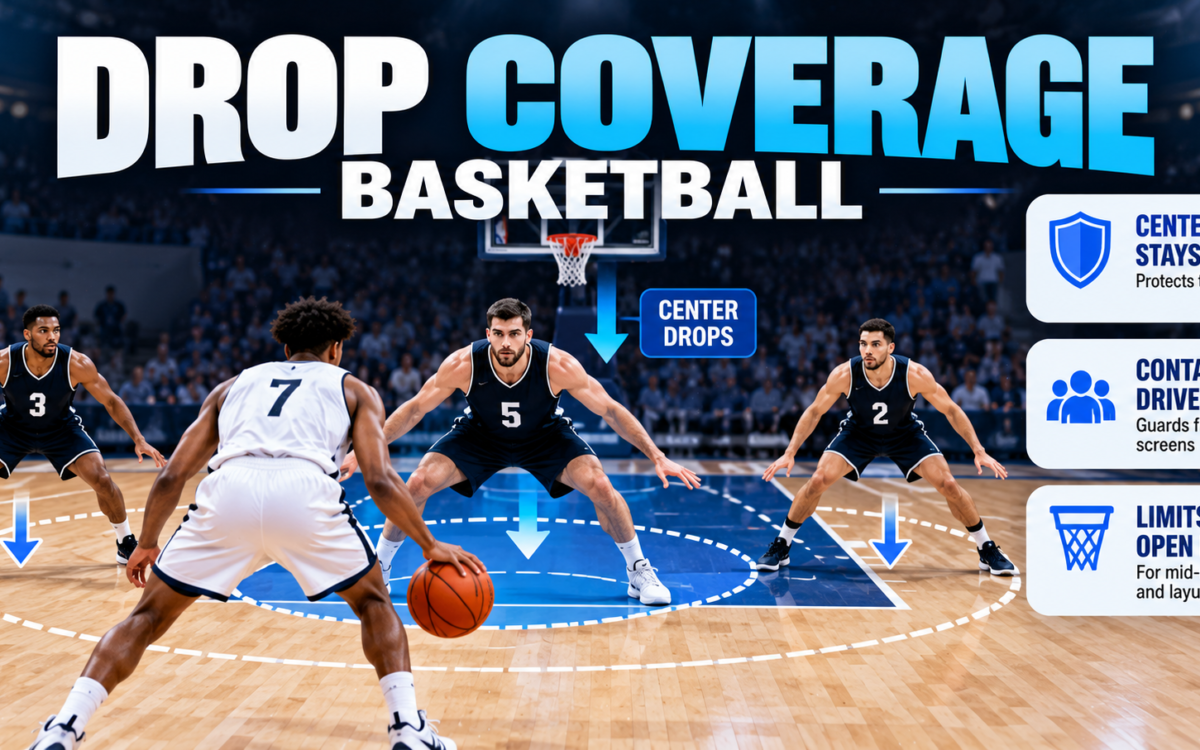
Drop coverage basketball is a pick-and-roll defensive strategy in which the defender guarding the screener retreats toward the basket instead of stepping up to the ball. The goal is to protect the rim while giving the on-ball defender time to recover. It is especially useful when a team wants its bigger defender near the paint rather than switching onto a guard.
What is drop coverage basketball?
Drop coverage is primarily used against ball screens and pick-and-roll actions. As the screener makes contact with the ball-handler’s defender, the screener’s defender stays below the level of the screen and moves toward the basket.
The on-ball defender usually fights over the screen and trails the ball-handler. The dropping defender temporarily positions himself between the ball, the rolling screener, and the rim, according to The Washington Post. according to The Washington Post
NBA analysis describes the coverage in much the same way. The big protects against drives and rolls while the original defender works back into the play.
How does drop coverage work?
A basic drop coverage can be broken into four actions:
- The offense sets a ball screen. A screener, often a center or forward, screens the defender guarding the ball.
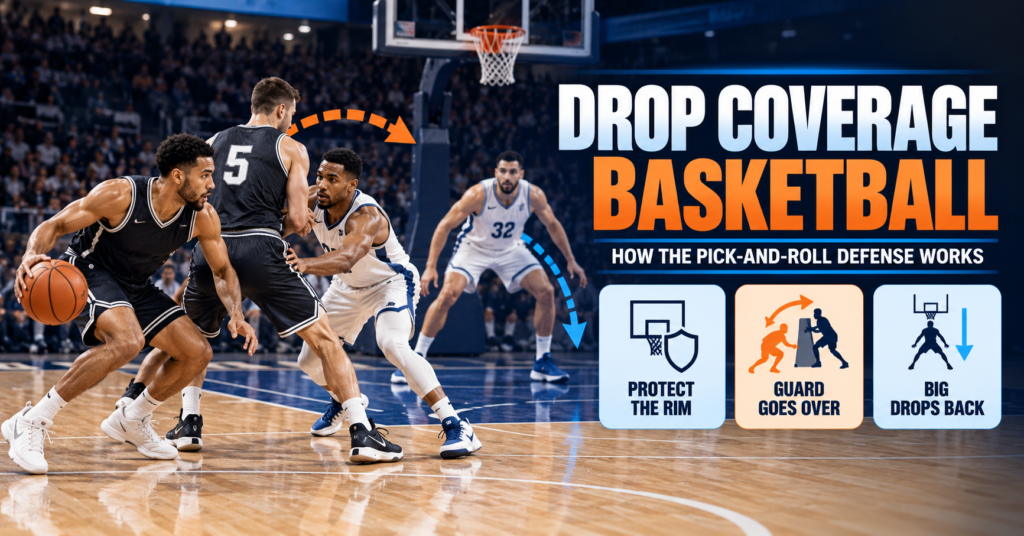
- The big defender drops. Instead of following the screener up toward the screen, that defender retreats toward the lane.
- The guard fights over. The on-ball defender goes over the screen and chases the ball-handler from behind.
- The defenders recover. Once the guard gets back in front, the big can return to the screener.
FIBA has described this as defending the pick-and-roll two against two, with the screener’s defender protecting the basket while the guard works over the screen.
The exact depth of the drop can change. A defender may stay near the free-throw line in a higher drop or retreat deeper into the paint in a low drop.
What each defender must do
Drop coverage depends heavily on coordination between two defenders.
The on-ball defender cannot simply stop playing after hitting the screen. They need to fight over it, stay attached to the ball-handler, and recover quickly enough to challenge a pull-up shot.
The screener’s defender has two threats to manage at once:
- Stop the ball-handler from reaching the rim.
- Prevent the screener from getting an uncontested roll to the basket.
Good positioning keeps the big between both offensive players and the hoop until the guard recovers.
Communication also matters. The big defender should alert the guard that a screen is coming so the guard can prepare to get over it.
Why teams use drop coverage
The biggest advantage of drop coverage is rim protection.
Keeping a center near the basket makes it harder for the ball-handler to turn the corner for a layup. It can also discourage direct passes to a screener rolling toward the rim.
Drop coverage has several other benefits:
- Keeps strong rim protectors close to the basket.
- Reduces the need to switch a big onto a fast guard.
- Can defend a pick-and-roll with two players instead of immediately sending extra help.
- Allows perimeter defenders away from the action to stay closer to shooters.
- Can force the offense toward less desirable shots.
That last point is important. FIBA examples show teams using drop-and-over coverage to protect the basket while accepting that a skilled ball-handler may find room for a mid-range pull-up.
What beats drop coverage?
Drop coverage protects certain areas of the floor by allowing more space in others.
One common counter is the pull-up jumper. If the big retreats too far and the trailing defender cannot recover, the ball-handler may stop around the free-throw line or elbow for an open shot.
Other common attacks include:
- Floaters: A guard can shoot before reaching the rim protector.
- Pocket passes: The ball-handler can slip a pass between the two defenders to the roller.
- Lobs: Athletic screeners can get behind the dropping defender.
- Pick-and-pop: A shooting big can screen and move away from the basket instead of rolling.
- Re-screens: The screener changes the angle and forces the defense to reposition.
- Short rolls: The screener catches around the foul line and attacks or passes from there.
FIBA tactical analysis shows how strong mid-range shooters can punish conservative drop positioning and how short-roll actions can force another layer of defensive decisions.
Drop coverage vs switching
Drop coverage and switching solve the pick-and-roll in different ways.
| Coverage | Screener’s defender | Main goal | Main risk |
| Drop | Retreats toward basket | Protect rim | Pull-up space |
| Switch | Takes ball-handler | Remove screen advantage | Mismatches |
| Hedge/show | Steps toward ball | Slow ball-handler | Roller can get free |
| Blitz | Traps ball-handler | Force ball out | 4-on-3 behind trap |
A team may prefer drop coverage when its center is an effective rim protector but is less comfortable defending quick guards far from the basket.
Switching can remove the immediate advantage created by a screen, but it may leave a smaller defender guarding a center or a big defending a guard in isolation, according to Wikipedia. according to Wikipedia
FAQs
Is drop coverage a zone defense?
No. Drop coverage is usually a pick-and-roll coverage within a man-to-man defensive system. It describes how defenders handle a particular screening action rather than how all five defenders guard the entire floor.
Why does the guard go over the screen?
Going over helps the defender recover toward a shooter who may pull up behind the screen. Jr. NBA practice material specifically trains guards to read situations where the defender goes over and the screener’s defender drops back.
What type of center works best in drop coverage?
A strong rim protector with size, positioning, awareness, and the ability to contain two offensive players temporarily is a good fit. The defender still needs enough mobility to adjust as the ball-handler approaches.
Can drop coverage stop good shooters?
It can, but elite pull-up shooters make the coverage harder to execute. The dropping defender may need to play higher, and the guard must recover quickly enough to contest before the ball-handler reaches comfortable shooting space.

James Carter
ContributorMore from Basketball
Diamond Press Basketball: How the 1-2-1-1 Press Works
Diamond press basketball is a full-court defensive strategy that uses a 1-2-1-1 alignment to pressure the inbound pass, trap the…
How Long Is a College Basketball Game? (2025-26 NCAA Rules)
How long is a college basketball game? Under 2025-26 NCAA rules, regulation remains 40 minutes: men play two 20-minute halves,…

When Is Basketball Season? NBA, College, High School & WNBA Dates
Basketball season usually runs from October or November through March or April, but the exact months depend on the league.…