PF Meaning in Basketball, Cleared Up


PF meaning in basketball depends entirely on where you see it. In a box score or stat line, PF stands for personal foul. In a lineup or depth chart next to a player’s name, it means power forward. Same two letters, two completely different things — and context resolves it every time.
What Does PF Mean in Basketball?
The confusion is real, and it trips up new fans constantly. The trick is location. If PF sits beside numbers, it’s a personal foul count. If it sits beside a name before tip-off, it’s a position. Experienced fans stop noticing the ambiguity because context answers it instantly.
PF as a Personal Foul
A personal foul is illegal physical contact with an opponent — reaching in, blocking, holding, or barreling into a defender who’s already set. On a box score, PF meaning in basketball here refers to that foul count, tucked in near blocks, steals, and turnovers. It’s easy to scroll past. Coaches don’t.
PF as a Power Forward
Power forward is one of five standard positions and lives in the frontcourt. Traditionally it’s the physical role: rebounding, scoring inside, and banging with opposing big men. You’ll see PF used this way in starting lineups and scouting notes, paired with a player’s name rather than a stat total.
How to Tell Which PF Is Meant
In practice, you almost never have to think about it. Quick rule: numbers nearby means personal foul, a player’s name nearby means power forward. The table below makes it visual.
| Personal Foul | Power Forward | |
| Full term | Personal foul | Power forward |
| What it describes | An infraction (illegal contact) | A player position |
| Where you see it | Box scores, stat sheets | Lineups, depth charts |
| Example | “He picked up his 4th PF.” | “She’s starting at PF tonight.” |
Personal Foul Explained
This is the meaning most stat-related searches are after, so it’s worth a closer look.
Types of Personal Fouls
Not all fouls are equal. A defensive foul covers reaching or holding. An offensive foul happens when the ball-handler initiates contact — the classic charge being the obvious example. Most are common fouls, fairly routine. Flagrant fouls involve excessive or dangerous contact and carry heavier penalties. Technical fouls get recorded separately and cover misconduct rather than physical contact.
Fouling Out and the Bonus
According to Wikipedia’s personal foul rules, a player who commits five personal fouls in a 40-minute game, or six in a 48-minute game, fouls out and is disqualified for the remainder of the game. In the NBA, that limit is six; in the NCAA and WNBA, it’s five. There’s also the team side: once a team racks up enough fouls in a period, the opponent enters the bonus and shoots free throws on non-shooting fouls. The NBA bonus kicks in after the fifth team foul in a quarter. The NCAA runs a one-and-one after seven team fouls in a half, then a double bonus after ten. FIBA handles penalties by quarter, and a few foul definitions differ from league to league.
Why Personal Fouls Matter
Fouls decide who’s on the floor. A player in foul trouble — say, three fouls early — often gets benched to avoid fouling out, forcing a coach to shuffle the rotation. Managing foul trouble is half the chess match in close games. One pattern worth noting: big men, centers and power forwards in particular, tend to pick up more fouls than guards simply because they’re defending the rim and contesting shots all night.
Power Forward Explained
The position has shifted considerably over the years, which is part of why the abbreviation feels less fixed than it used to.
Core Responsibilities
The traditional power forward role is physical work: grabbing rebounds at both ends, scoring close to the basket, setting screens, and defending the opposing team’s bigger players. As noted by Wikipedia’s basketball positions page, modern power forwards now emphasize perimeter play — including ball-handling and three-point shooting — and are expected to switch onto quicker, more dynamic opponents on defense. It’s a genuine departure from the role decades ago.
PF vs Nearby Positions
People commonly mix up the power forward with the center, but the power forward is generally more mobile while the center sticks closer to the rim. Against a small forward, the difference is emphasis: the power forward leans on strength and rebounding, the small forward on perimeter scoring and quickness. The lines blur on many rosters, and that’s fine — lineups don’t always match the textbook.
Conclusion
PF means personal foul in stats and power forward as a position. Location tells you which: numbers nearby mean a foul, a player’s name nearby means the position. Knowing both lets you read box scores and lineups in 2026 without second-guessing.
Frequently Asked Questions
What does PF stand for in basketball?
PF stands for personal foul in stat sheets and box scores, or power forward when it refers to a player’s position. Context tells you which one applies.
How many personal fouls before fouling out?
In the NBA, six personal fouls disqualify a player. In the NCAA and WNBA, the limit is five. After that, the player cannot return to the game.
Does PF in a box score mean power forward?
No. In a box score, PF means personal fouls — the count of infractions a player committed. Power forward appears in lineups and depth charts, not stat columns.
Is a power forward the same as a center?
No. A power forward is generally more mobile and plays a bit farther from the basket, while the center stays closer to the rim and focuses on interior play.
Which players commit the most personal fouls?
Big men — centers and power forwards — tend to record more personal fouls than guards because they defend the paint and contest shots more often. It’s a tendency, not a guarantee.

James Carter
ContributorMore from Basketball
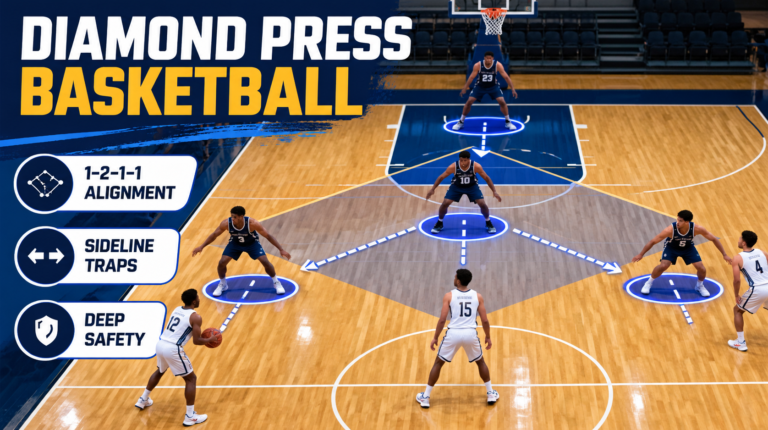
Diamond Press Basketball: How the 1-2-1-1 Press Works
Diamond press basketball is a full-court defensive strategy that uses a 1-2-1-1 alignment to pressure the inbound pass, trap the…
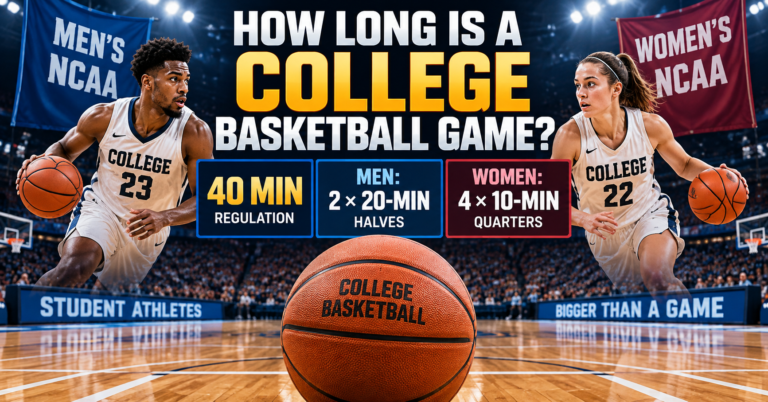
How Long Is a College Basketball Game? (2025-26 NCAA Rules)
How long is a college basketball game? Under 2025-26 NCAA rules, regulation remains 40 minutes: men play two 20-minute halves,…

When Is Basketball Season? NBA, College, High School & WNBA Dates
Basketball season usually runs from October or November through March or April, but the exact months depend on the league.…