2-3 Zone Defense: How It Works, Positions, and Trapping


A 2-3 zone defense is a half-court setup where five defenders guard areas of the floor instead of specific opponents. Two guards play up top, three players line the baseline. It protects the paint and pushes the offense toward outside shots.
That sounds simple. Running it well is not. Below is how the alignment works, where everyone moves as the ball travels, when to trap, and the trade-offs you accept by playing it.
What Is a 2-3 Zone Defense?
The name describes the shape. Two players across the top, three across the bottom. It’s the most common zone in basketball, and for a lot of coaches it’s the first thing that comes to mind when someone says the word “zone,” according to Wikipedia.
Here’s the part that trips people up. In a 2-3 zone, your players aren’t chasing a man around the court. They’re each responsible for a slice of the floor. The ball moves, the slices shift, and defenders pass coverage off to each other as they go. Those areas overlap constantly, especially near the ball, which is exactly why the spacing and timing matter so much.
Basic Alignment and Player Roles
Five spots, five jobs:
- Guards (1 and 2): Across the top, near each high-post elbow.
- Forwards (3 and 4): A step outside each block.
- Center (5): Planted in the middle of the key.
The two guards handle the perimeter up high. The three baseline players protect the rim and the corners. In practice, most teams find the center rarely needs to leave the paint, which is a big reason this zone keeps the ball away from the basket so well.
How the 2-3 Zone Defense Differs From Man-to-Man
The whole mental shift is area versus person. A man defender follows one player wherever he goes. A zone defender holds ground and reacts to the ball. That difference is why a zone can wear down an offense that isn’t patient, and also why it leaves gaps a sharp passing team can find.
It gets associated with Jim Boeheim and Syracuse — who ran this scheme for decades at the highest level of college basketball, according to Wikipedia — mostly because they built a long, well-known run around it. Worth knowing as context, but you don’t need a famous program to run it. Any team can.
Advantages and Weaknesses of the 2-3 Zone
No defense is free. You’re trading one set of problems for another, and it helps to know which problems you’re choosing.
What It Does Well
It packs the paint. With the center anchored inside and help always close, getting a clean look at the rim is hard. It controls tempo too, which is underrated. Want a slower game? Sit back and stay patient. Want chaos? Trap and gamble. Teams commonly report fewer fouls out of a zone as well, partly because defenders aren’t getting beaten off the dribble one-on-one as often. And because the offense has to work to get a decent shot, rushed teams tend to throw up contested ones.
Where It Breaks Down
Outside shooting. That’s the headline weakness, and it’s not close. If a team can knock down perimeter shots, the zone’s whole logic starts to crack, because packing the paint means leaving room out high.
Rebounding is the other one. Nobody has a fixed man to box out, so boxing out becomes a scramble. The offense can also pick its matchups, parking its best player wherever your weakest defender is. And the zone only works if all five players hold up their end. One lazy rotation and the gaps open fast.
Advantages vs. Weaknesses at a Glance
| Strengths | Weaknesses |
| Protects the paint and the rim | Vulnerable to strong outside shooting |
| Controls game tempo (fast or slow) | Harder to rebound, no fixed matchups |
| Tends to limit fouling | Offense can choose mismatches |
| Forces lower-percentage perimeter shots | Falls apart if one player doesn’t rotate |
The Core Rules of a 2-3 Zone
Before the rotations, there are a few non-negotiables. Get these wrong and the rest doesn’t matter.
Active hands, low stance. Good passing kills a zone. Hands up and active discourages the inside pass and turns mistakes into deflections. A real stance means you react on time instead of a half-step late.
Move on the flight of the ball. Not on the catch. The flight. If your players wait until the ball lands to start moving, they’re already behind. Beating the pass to its spot is most of what separates a good zone from a leaky one.
Talk. Screens, cutters, who’s got the ball, who’s bumping. Quiet zones get carved up. In practice, the teams that defend the zone well are almost always the loud ones.
No layups. Sounds obvious. Has to be said anyway. Whatever else happens, don’t give up easy baskets at the rim.
Positions and Rotations by Ball Location
This is where the zone actually lives. The setup is static; the defense isn’t. Here’s how it shifts depending on where the ball sits.
Ball at the Top of the Key
This is your base look. Two guards up, two forwards out from the block, center in the middle. The guards stay close enough to nearly touch hands, because the one thing you can’t allow is the point guard splitting them or slipping a pass into the high post. Force the ball to a wing instead. That’s the outcome you want here.
Ball on the Wing
Once it goes to the wing, the ball-side forward jumps out to pressure the ball while the guard sprints over to recover. As the guard arrives, the forward drops back to the baseline. That hand-off is called “bumping,” and it’s the engine of the whole defense. Meanwhile the weak-side guard slides toward the elbow and the weak-side forward creeps up the lane, watching for a skip pass.
Ball in the Corner or Short Corner
The ball-side forward steps out to pressure. The center fronts the low post so no easy entry pass gets in. The ball-side guard now has a choice: sag into the lane to wall off the drive and the inside pass, or fully deny the kick-back to the wing and force the corner player to make a decision. Which one depends on who you’re guarding.
Ball in the High Post
This is the soft spot. Once a good passer catches it at the high post, every teammate is one quick pass from a clean look. The center sprints up to play the ball. Both forwards pinch in to kill the high-low pass for a layup. Both guards collapse to pressure and force the ball back out. The honest answer here, the one most coaches land on, is that the best way to defend the high post is to never let the ball get there.
Bumping, Explained
Two guards. Three perimeter spots to cover up top. The math doesn’t work on its own, which is the structural flaw built into every 2-3 zone. Bumping is the fix. On a ball reversal or a skip pass, the closest forward jumps out to cover the open wing for a beat, holding it just long enough for the guard to recover and “bump” him back down to the baseline. It’s how two players defend three, and when it’s timed badly, it’s also where open three-pointers come from.
Trapping Out of the 2-3 Zone
Trapping is optional. Some teams never do it, some build their whole identity around it. The key thing: a steal rarely comes from the two players doing the trapping. It comes from a third defender reading the panicked pass and jumping it. Force the offense to throw high over the trap, and let your interceptors do the work.
Trap at the Top of the Key
Both guards sprint at the ball handler the instant he crosses half court while the forwards deny the wings. High risk. It’s a surprise weapon, the kind of thing you pull out once or twice a game, often off a timeout or late when you badly need a stop.
Trap on the Wing
The ball-side forward and guard double the wing instead of bumping. The trouble is that the wing player usually has too many easy outlets to pass out of it. Useful as an occasional surprise, less so as a staple.
Trap in the Corner
The most effective trap location in this defense, by general agreement. The corner is a dead end — the sideline and baseline do half your work — and any pass out has to travel long and high, right into your interceptors’ hands. Get a few steals here and offenses simply stop passing to the corner, which makes the whole zone easier to play.
Trap in the Short Corner and Post
Treated almost as automatic. When the ball gets that close to the rim, you double immediately to get it back out. The point isn’t always the steal — it’s clearing the danger and resetting your shape.
| Trap Location | Players Involved | Risk Level | Typical Use |
| Top of the key | Both guards | High | Surprise, once or twice a game |
| Wing | Ball-side forward + guard | Medium-high | Occasional change-up |
| Corner | Ball-side forward + guard | Lower | The go-to trap for many teams |
| Short corner / post | Center + ball-side forward | Lower | Near-automatic to clear the ball |
Rebounding Out of the 2-3 Zone
This deserves its own honest paragraph, because it’s the cost nobody likes paying. Since defenders guard space, not people, nobody has a clear man to box out when the shot goes up. Whoever’s closest has to find a body, fast.
How teams handle it varies. Bigger teams might leave rebounding to the three baseline players and let the guards leak out for fast breaks. Smaller teams often need all five crashing the glass. There’s no single right answer here — it depends on your personnel. What doesn’t change is the demand to box out and chase, every possession, because a zone will give up more second-chance looks than a man defense if you let it.
Adjusting the 2-3 Zone to Your Team and Opponent
The myth that the 2-3 is a one-size, slow-team defense doesn’t hold up. It bends to fit who you have.
Adjusting to Your Personnel
Fast, athletic group? Trap more, pressure the ball, gamble for steals, push the tempo up. Bigger and slower? Sit back, limit the traps, stay disciplined, and wait for the offense to take a bad shot on its own. Same defense, two completely different speeds.
Adjusting to the Opponent
Against good shooters, you can shade your guards toward the dangerous ones and sag off the weak ones. Among coaches, the common approach is to pick who shoots rather than try to stop all shooting entirely. Against a strong post player, the surrounding defenders shade in to choke off the entry pass. And if you want pressure, a 2-2-1 press flows naturally into the 2-3 since the alignment already matches.
Conclusion
A 2-3 zone defense trades perimeter exposure for paint protection and tempo control. It rewards five players who rotate on the flight of the ball, communicate, and box out. Played lazily, it leaks. Played with discipline, it’s genuinely hard to score against.
Frequently Asked Questions
What is the main weakness of a 2-3 zone defense?
Outside shooting. Packing the paint leaves space on the perimeter, so a team that shoots well from distance can stretch the zone and pull defenders out of their most valuable positions near the rim.
Why is it called a “2-3” zone?
The numbers describe the formation. Two players line up across the top of the zone, and three players spread across the baseline, giving it the recognizable two-up, three-back shape.
Is the 2-3 zone a passive or lazy defense?
No. A good 2-3 zone takes as much effort as man-to-man. Constant rotations, closeouts, communication, and box-outs are exhausting. The “lazy” label only fits a team that plays it without discipline.
What does “bumping” mean in a 2-3 zone?
Bumping is when a forward briefly steps out to cover an open wing, then drops back as the guard recovers to that spot. It lets two top defenders cover three perimeter positions.
Which trap is most effective in a 2-3 zone?
The corner trap. The sideline and baseline limit the offense’s options, forcing a long, high pass out that your other defenders can read and intercept for easy transition baskets.

James Carter
ContributorMore from Basketball
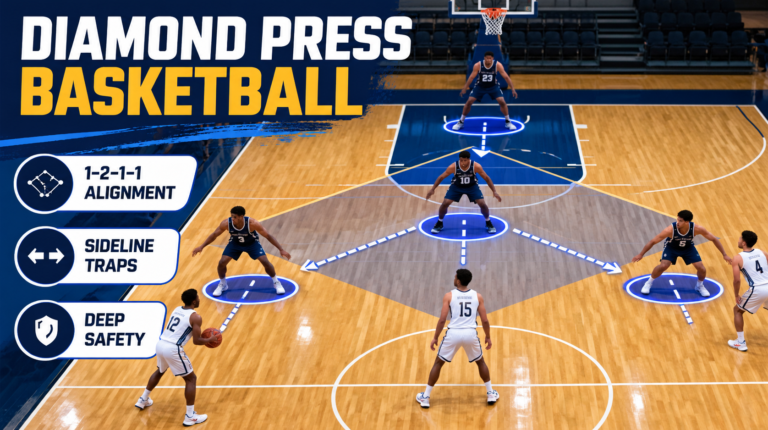
Diamond Press Basketball: How the 1-2-1-1 Press Works
Diamond press basketball is a full-court defensive strategy that uses a 1-2-1-1 alignment to pressure the inbound pass, trap the…
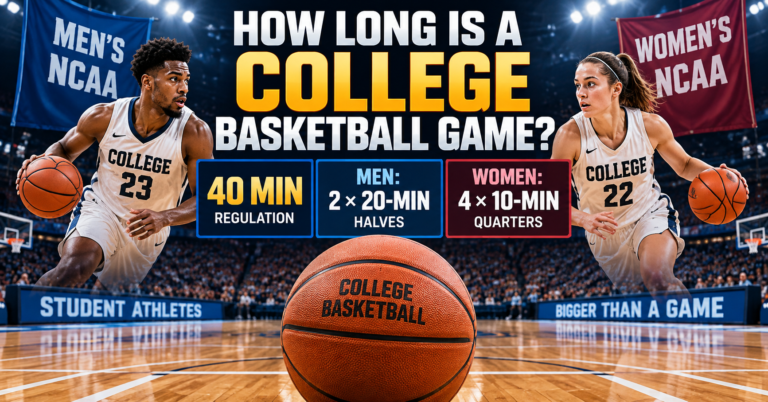
How Long Is a College Basketball Game? (2025-26 NCAA Rules)
How long is a college basketball game? Under 2025-26 NCAA rules, regulation remains 40 minutes: men play two 20-minute halves,…

When Is Basketball Season? NBA, College, High School & WNBA Dates
Basketball season usually runs from October or November through March or April, but the exact months depend on the league.…