How Long Is a College Basketball Game? NCAA Timing Explained

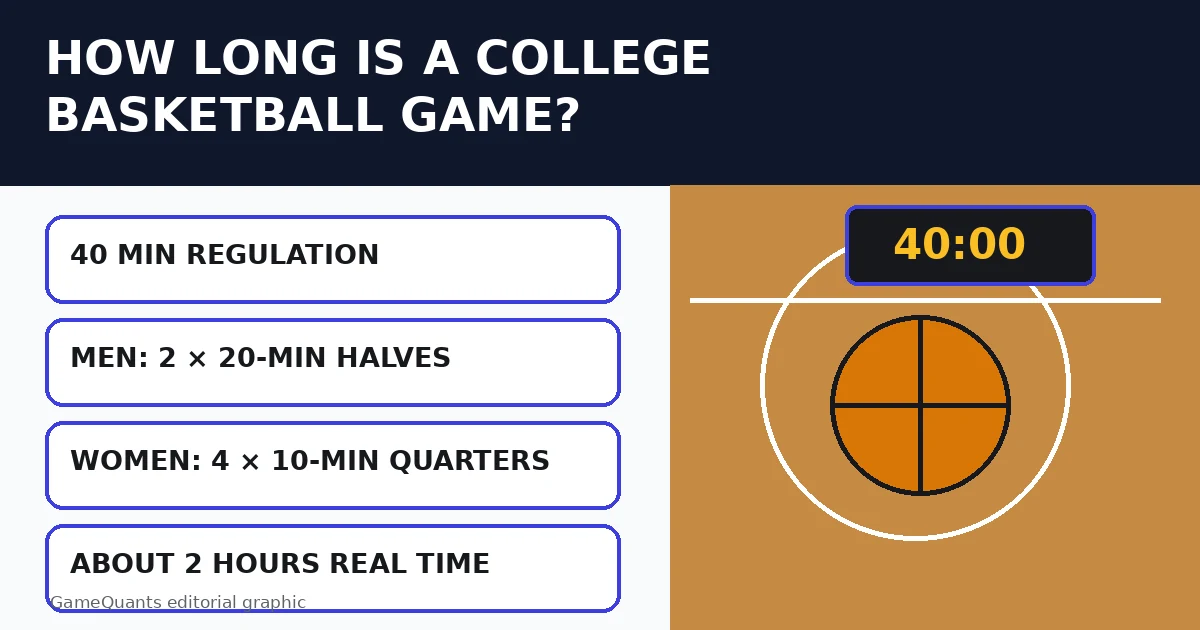
A college basketball game has 40 minutes of regulation playing time, but watching a full game usually takes about two hours. Men’s NCAA basketball uses two 20-minute halves, while women’s NCAA basketball divides the same 40 minutes into four 10-minute quarters. Fouls, timeouts, halftime, replay reviews, and overtime make the real-world duration much longer than the game clock.
How long is a college basketball game?
For NCAA men’s basketball, regulation consists of two 20-minute halves, for 40 minutes on the game clock. If the score is tied after regulation, teams play a five-minute overtime period. Additional five-minute overtimes are played if the score remains tied.
Women’s college basketball also has 40 minutes of regulation, but its structure is different. NCAA women’s games have four 10-minute quarters rather than two halves. The NCAA adopted the four-quarter format beginning with the 2015-16 season. These timing differences are also documented according to Wikipedia.
| College basketball format | Regulation time | Structure | Overtime |
| NCAA men | 40 minutes | Two 20-minute halves | 5 minutes |
| NCAA women | 40 minutes | Four 10-minute quarters | 5 minutes |
The NCAA was still using the two-half format for men’s basketball entering 2026-27. NCAA rules committees discussed a possible future move to four quarters in May 2026, but it was an evaluation rather than an adopted format change.
Why do games take two hours?
The game clock stops frequently, so 40 minutes of basketball does not translate into a 40-minute event.
Several stoppages can increase the total length:
- Fouls and free throws
- Team timeouts
- Media timeouts
- Halftime
- Out-of-bounds plays and other dead balls
- Injuries
- Officials’ discussions
- Instant replay reviews
- Overtime periods
An NCAA analysis of the 2017-18 Division I men’s regular season reported an average game length of 1 hour, 57 minutes. Experimental 2018 NIT games lasted between 2 hours, 1 minute and 2 hours, 6 minutes depending on the timeout format.
That makes roughly two hours a useful planning estimate for a typical college basketball game. A close contest with frequent late fouls or overtime can run considerably longer.
How long is halftime?
Halftime creates one of the biggest differences between game-clock time and elapsed time.
In men’s basketball, halftime comes after the first 20-minute half. In women’s basketball, it occurs between the second and third quarters.
For spectators, halftime adds a substantial break before play resumes. There can also be shorter interruptions within each half or quarter, especially during televised games.
Men’s college basketball generally uses scheduled media breaks after dead balls around specific points in each half. The NCAA has historically placed these around the under-16, under-12, under-8 and under-4-minute marks, although formats can vary in certain competitions or experimental settings.
What makes a game run longer?
Late-game fouling can stretch the final minutes significantly. A team that is behind may intentionally foul to stop the clock and force its opponent to shoot free throws. Timeouts between possessions can add further delays. The effect can be dramatic: a 2014 NCAA tournament game took 18 minutes and 9 seconds to complete its final 60 seconds, as reported by The Guardian.
Replay is another factor. For the 2025-26 men’s season, the NCAA approved a coach’s challenge covering certain reviewable plays. Officials also retain replay authority for specified situations such as timing errors, scoring errors, shot-clock violations and some foul situations.
The NCAA has continued looking at ways to improve game flow. Its men’s basketball committees discussed overall game length and possible changes again in 2026.
How long does overtime take?
Each college basketball overtime period adds five minutes to the game clock.
The actual addition to elapsed time is longer than five minutes because the clock can stop for fouls, free throws, timeouts and reviews. A tightly contested overtime period can therefore extend the event well beyond its scheduled finish.
There is no single-overtime limit. If the teams remain tied, another overtime period is played. Multiple-overtime games can consequently last much longer than the normal two-hour range.
College vs NBA game length
College and NBA basketball have different regulation lengths.
NCAA men’s basketball has 40 minutes of regulation, while an NBA game has 48 minutes. NBA games consist of four 12-minute quarters rather than the NCAA men’s two 20-minute halves. Both use five-minute overtime periods.
| Format | Regulation | Period structure |
| NCAA men | 40 minutes | 2 × 20-minute halves |
| NCAA women | 40 minutes | 4 × 10-minute quarters |
| NBA | 48 minutes | 4 × 12-minute quarters |
So even though NBA regulation contains eight more minutes of game-clock action, both college and professional games take substantially longer in real time because the clock stops throughout play.
FAQs
How long is an NCAA men’s basketball game?
An NCAA men’s basketball game has 40 minutes of regulation playing time, divided into two 20-minute halves. In real time, planning for roughly two hours is reasonable.
How long is a women’s college basketball game?
A women’s NCAA basketball game has 40 minutes of regulation, divided into four 10-minute quarters. Overtime periods add five minutes of game-clock time when needed.
How long does March Madness game last?
A men’s March Madness game uses the standard NCAA format of 40 regulation minutes divided into two 20-minute halves. The actual event lasts much longer because of halftime, fouls, free throws, media breaks, reviews and other stoppages.
Can a college basketball game last three hours?
Yes. Although roughly two hours is a useful expectation, overtime, frequent fouls, replay reviews and other stoppages can push a college basketball game well beyond that mark.
Conclusion
So, how long is a college basketball game? Regulation lasts 40 minutes, while the full event commonly takes around two hours. Expect additional time when a game includes frequent stoppages, late fouling, replay reviews or overtime.

Editorial Team
ContributorMore from Basketball
Diamond Press Basketball: How the 1-2-1-1 Press Works
Diamond press basketball is a full-court defensive strategy that uses a 1-2-1-1 alignment to pressure the inbound pass, trap the…
How Long Is a College Basketball Game? (2025-26 NCAA Rules)
How long is a college basketball game? Under 2025-26 NCAA rules, regulation remains 40 minutes: men play two 20-minute halves,…

When Is Basketball Season? NBA, College, High School & WNBA Dates
Basketball season usually runs from October or November through March or April, but the exact months depend on the league.…