What’s the Difference Between Pickleball and Tennis?
The main difference between pickleball and tennis is scale: a 20 x 44 ft court, solid paddle, plastic ball, underhand serve, a kitchen and games to 11.

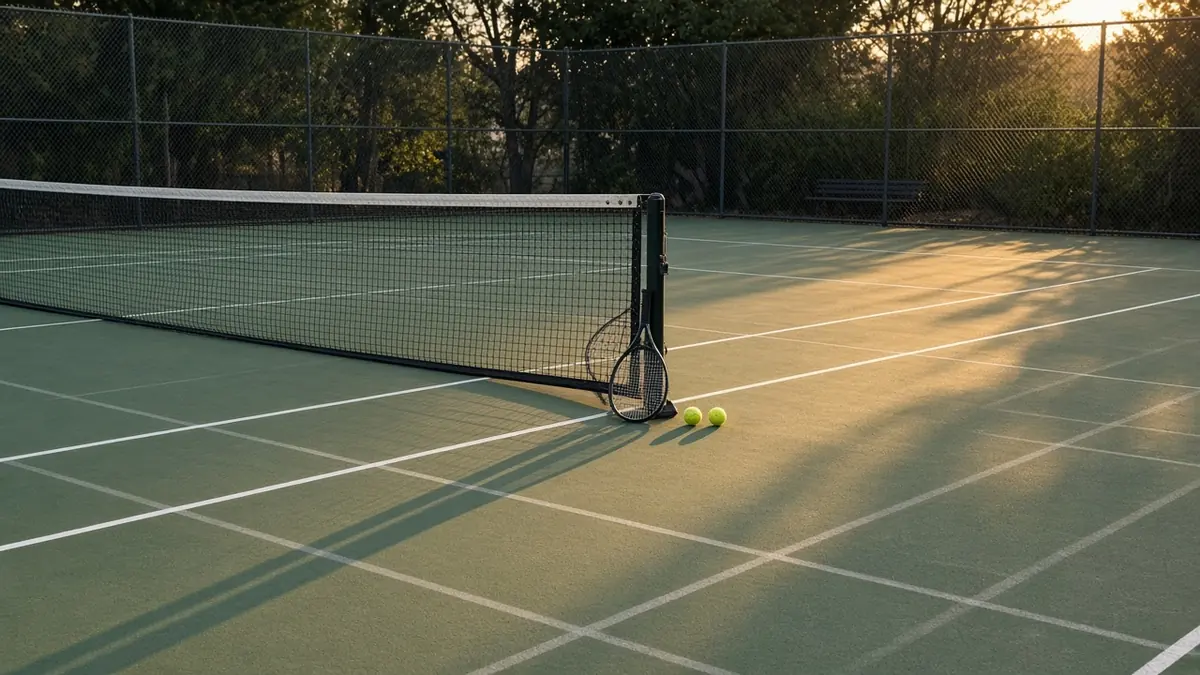
The main difference between pickleball and tennis is scale. Pickleball is played on a 20 by 44 ft court, under a third of a tennis doubles court, with a solid paddle, a perforated plastic ball, an underhand-style serve, a 7-foot no-volley “kitchen” and games to 11 where usually only the serving side scores. Tennis uses a strung racket, a felt ball, a 78 by 36 ft court, overhead serves and 15-30-40 scoring.
Those differences change how hard you swing, where you stand and how long a point lasts. Every number below comes from USA Pickleball’s 2026 Official Rulebook or the ITF’s 2026 Rules of Tennis.
Key takeaways
The difference between pickleball and tennis at a glance
Pickleball figures cite the 2026 USA Pickleball Official Rulebook; tennis figures cite the ITF Rules of Tennis 2026.
| Feature | Pickleball (USAP 2026) | Tennis (ITF 2026) |
|---|---|---|
| Court | 20 × 44 ft for singles and doubles (Rule 3.A.1) | 78 ft long; 27 ft wide singles, 36 ft doubles (Rule 1) |
| Net height | 36 in at sidelines, 34 in at center (Rules 3.B.6, 3.B.7) | 3 ft 6 in at posts, 3 ft at center |
| Hitting tool | Solid paddle; length + width ≤ 24 in, length ≤ 17 in (Rule 3.D.2) | Strung racket up to 29 in long and 12.5 in wide |
| Ball | Smooth, molded, perforated; bigger holes indoors, smaller outdoors (Rule 3.C.5) | Fabric-covered, 6.54 to 6.86 cm (about 2.6 in) across |
| Serve | Upward-arc volley serve or drop serve; one attempt (Section 7) | Any motion, usually overhead; second serve after a fault |
| Volleys | Not allowed while touching the 7-ft non-volley zone (Rule 11.A) | Allowed anywhere after the serve bounces |
| Scoring | Points on serve only; games usually to 11, win by 2 (Section 1, Rule 4.A) | 15, 30, 40, game; sets to 6 games, tie-break at 6-all |
How big is a pickleball court compared to a tennis court?
A pickleball court covers 880 sq ft (20 × 44). A tennis doubles court covers 2,808 sq ft (36 × 78), about 3.2 times as much. Width tells the real story: a tennis singles player guards 27 ft alone, while each pickleball doubles player guards about 10.
That’s why converted tennis courts usually hold four pickleball courts. The common 60 × 120 ft tennis enclosure follows the ITF’s recommended run-off of 21 ft behind each baseline and 12 ft at each side. USA Pickleball’s minimum playing surface is 30 × 60 ft (Rule 3.A.3), so four tile it in a 2 × 2 grid.
The fit only works at the minimum. At the 34 × 64 ft size the rulebook recommends for new construction, four courts won’t fit in that enclosure without sharing run-off space.
Is the pickleball net lower than a tennis net?
Yes, though less at the center than most people guess. A pickleball net is 34 in at center and 36 in at the sidelines. A tennis net is 36 in at center and 42 in at the posts.
So the gap is 2 inches in the middle and 6 at the edges. Playing pickleball on a tennis court with the tennis net still up? The center strap needs to come down 2 inches to hit 34.
Serving and the kitchen: the rules tennis players trip on
Pickleball’s serve is deliberately tame. A volley serve needs a clear upward arc, the ball no higher than the waist and the top of the paddle head no higher than the wrist (Rule 7.C). A drop serve, where the ball bounces first, is also legal (Rule 7.D). You get one try.
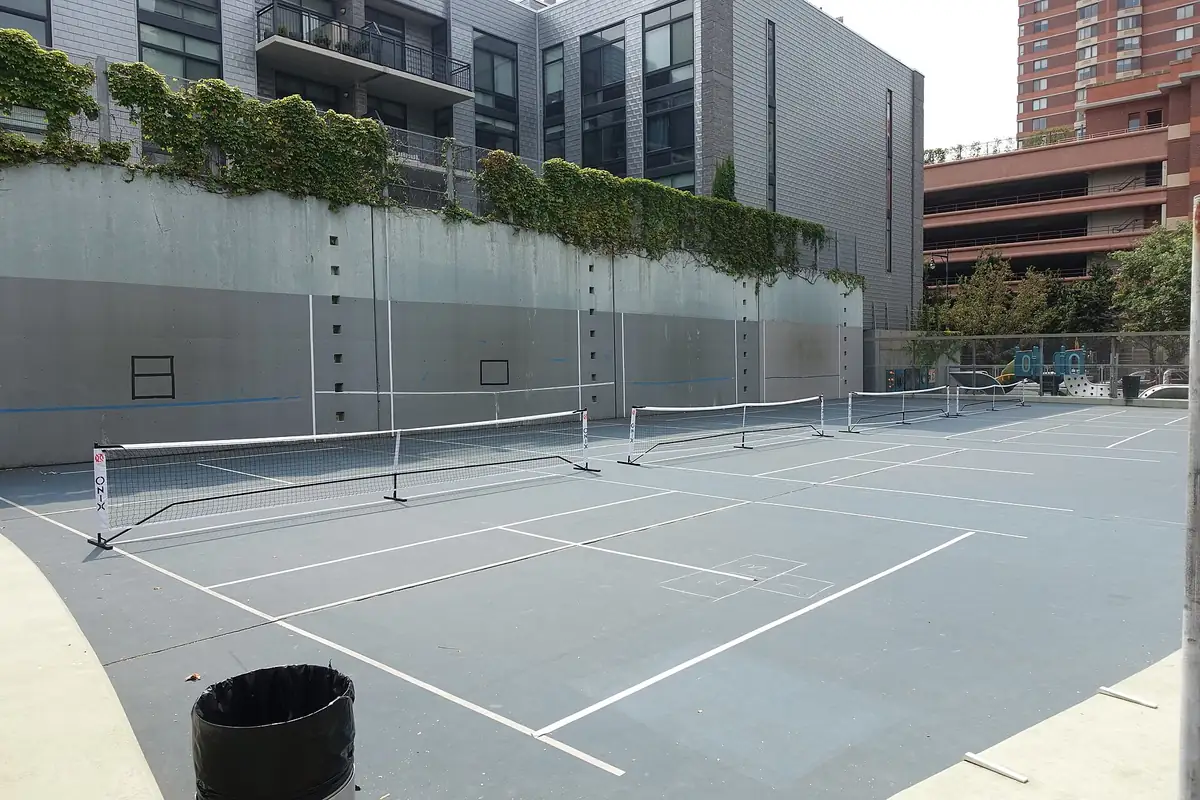
Tennis lets you serve overhead as hard as you like, with a second serve if the first misses.
Then comes the kitchen, the 7 × 20 ft non-volley zone on each side of the net. You can stand in it any time. You can’t volley while touching it, and momentum that carries you into it after a volley is still a fault (Rules 11.A.1 and 11.A.2).
Add the two-bounce rule (Rule 10.A), which makes both the serve and the return bounce, and tennis-style serve-and-volley is off the table.
Scoring: 11 points vs 15-30-40
In standard pickleball, only the serving side scores. Games usually go to 11, win by 2. In doubles, both partners serve before a side out, and the score is called as three numbers (Rule 6.B.2). Our guide to keeping score in pickleball untangles that third number. Rally scoring exists as a provisional option (Rule 14.A).
Tennis counts 15, 30, 40 and game, needs two clear points from deuce, and takes sets at six games with a two-game margin, using a tie-break at 6-all.
The practical result: pickleball games are short enough that open-play courts rotate players after every one. For real timings by format, see how long a pickleball game lasts.
Paddle and ball vs racket and ball
A pickleball paddle is a solid, unstrung face capped at 17 in long and 24 in combined length and width. A tennis racket can reach 29 in long and 12.5 in wide, with strings that act like a trampoline.
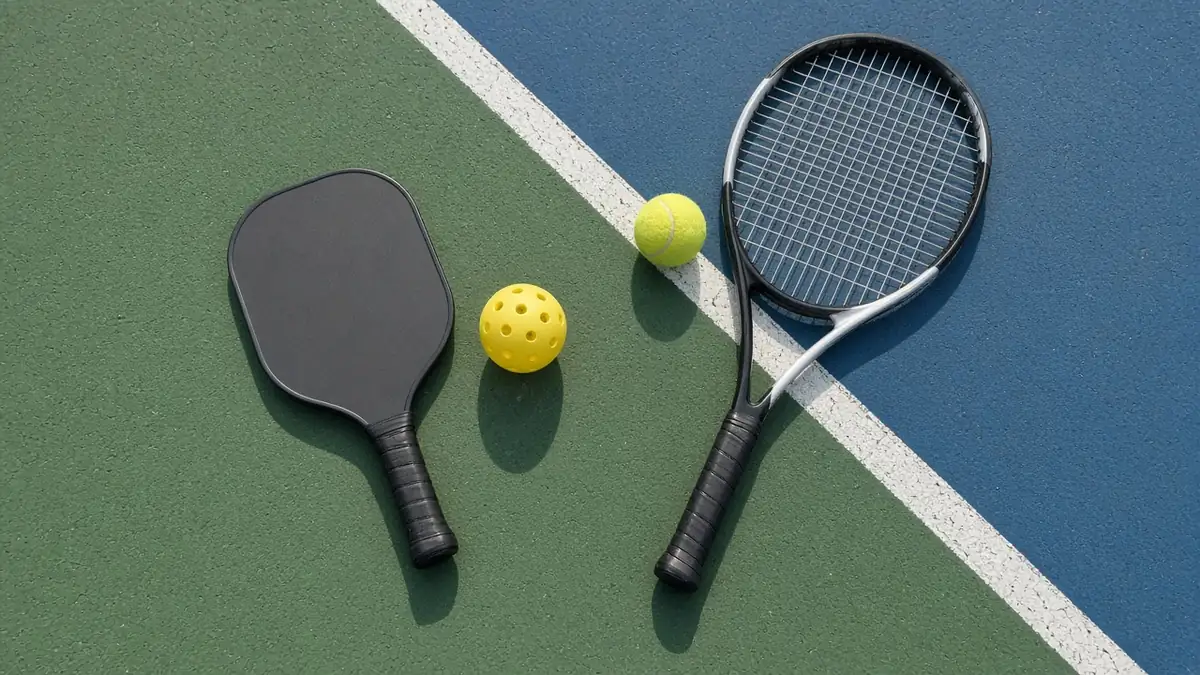
The balls are just as different. USA Pickleball requires a smooth, molded ball free of texturing, with larger holes typically used indoors and smaller holes outdoors (Rules 3.C.1 to 3.C.5). An ITF tennis ball is fabric-covered and 6.54 to 6.86 cm across.
Pickleball vs tennis vs padel
Padel is the third racket sport people lump in with these two. Under the International Padel Federation’s rules, it’s played on a 20 × 10 m court (about 2,153 sq ft) enclosed by glass and mesh walls, and the ball can be played off them.
The serve is underhand: the server bounces the ball and strikes it at or below waist height. Scoring copies tennis, with 15, 30, 40, game and sets to six. The racket is solid and perforated, with no strings, and most play is doubles.
On size, padel sits in the middle: about 2.4 times a pickleball court and roughly three quarters of a tennis doubles court.
Which one should you play?
Our take: pickleball is quicker to start. A smaller court, a lighter paddle and a capped serve mean beginners get real rallies in their first session. Our breakdown of whether pickleball is easier than tennis goes deeper on that learning curve.
Tennis asks more early but gives you more space to hit through mistakes. Tennis players who switch keep their footwork and drives; what they have to unlearn is the big backswing at the net and the instinct to charge in behind the serve.
Best test: book a tennis court, tape a pickleball court inside it, and play both in the same afternoon.
FAQ
Can you use a tennis ball to play pickleball?
Not under the rules. Rule 3.C.2 of the 2026 USA Pickleball rulebook requires a ball design USA Pickleball has approved, and Rule 3.C.5 calls for a smooth molded surface free of texturing, which a felt tennis ball isn’t. In a backyard game nobody will stop you, but the bounce and speed won’t feel like pickleball.
Do tennis skills transfer to pickleball?
Mostly, yes. Footwork, split steps and groundstroke mechanics carry over. What doesn’t: long backswings near the net, overhead serves (illegal under Rule 7.C) and rushing forward behind your serve, which the two-bounce rule punishes. Most tennis players need a few sessions to shorten their swing for a lighter paddle.
Is pickleball good exercise compared with tennis?
Yes, though tennis usually asks more of your legs per point: a tennis doubles court covers 3.2 times the ground of a pickleball court, and a singles player guards 27 ft of width alone. Pickleball’s quick kitchen exchanges still add up over a session. Our guide to whether pickleball is good exercise covers the details.
Can you play pickleball on a tennis court?
Yes. Four 30 × 60 ft pickleball playing surfaces fit inside a standard 60 × 120 ft tennis enclosure. You’ll need pickleball lines, painted or taped, and either portable nets or the tennis net strapped down 2 inches to 34 in at center. Remember the tennis net is far wider than a pickleball court.

Ava Sinclair
Lead Analyst, ChessAva builds GameQuants' engine-evaluation and rating-system models and leads data-quality review across the desk.
More from More Sports
What Is the Best Pickleball Paddle? (2026 Buyer’s Guide)
The best pickleball paddle for most players in 2026 is the Bread & Butter Loco 2 Hybrid. Plus our picks…
How Much Does It Cost to Build a Pickleball Court?
Building an outdoor pickleball court costs $20,000 to $50,000, about $34,000 on average in 2026. See what drives the price…
How Long Is a Pickleball Court? (44 Feet, Explained)
A pickleball court is 44 feet long and 20 feet wide for singles and doubles, but you need a 60…