Skinny Singles Pickleball: Rules, Scoring, and How to Play

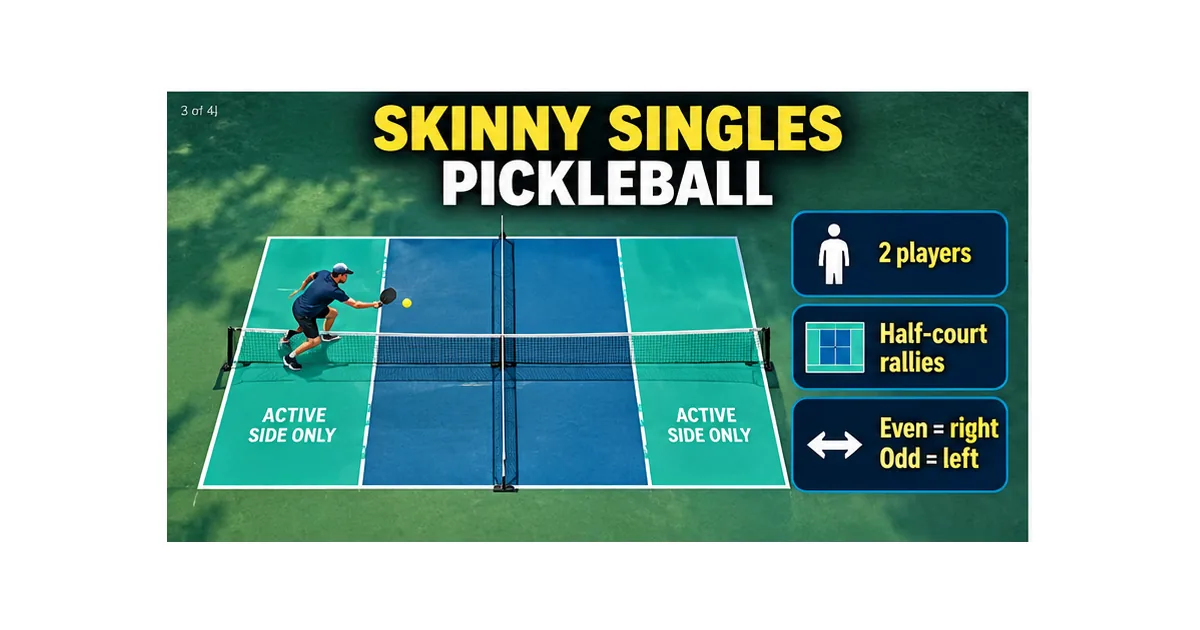
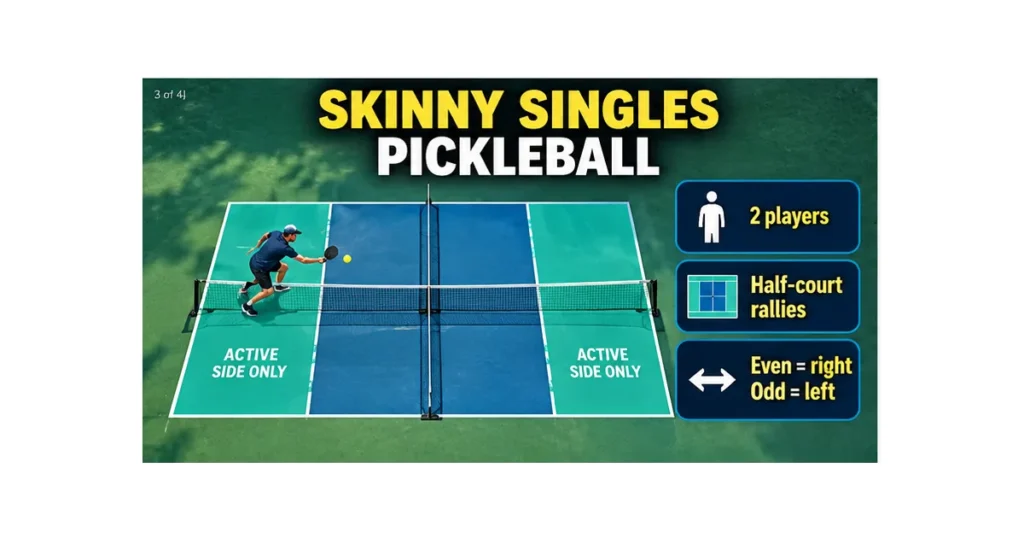
Skinny singles pickleball is a one-on-one version of pickleball where each player uses only half of the court during a rally, according to Wikipedia. USA Pickleball officially calls the format mini-singles. It keeps many singles rules but reduces the amount of court each player must cover, making it useful for practice, controlled rallies, and two-player games.
What is skinny singles pickleball?
Skinny singles is played by two players on a standard 20-by-44-foot pickleball court, according to Forbes, but only the right or left half of each end is in bounds for a given rally. The active half depends on each player’s individual score.
Under the 2026 USA Pickleball rules for mini-singles, an even score puts a player on the right side, while an odd score puts that player on the left. Because the players use their own scores, rallies can be played diagonally across the net or straight ahead.
All normal singles rules apply unless the mini-singles rules specifically change them.
How to set up the court
Start with a normal pickleball court. The standard centerline divides the service courts from the baseline to the non-volley zone, but skinny singles needs that line extended through the kitchen to the net.
This added line creates a clear boundary for the half-court playing area. For each rally, the live boundaries are:
- The baseline
- One outside sideline
- The centerline
- The net
A ball landing on the unused half of the opponent’s court is out. USA Pickleball allows the added centerline through the non-volley zone to be a different color from the permanent court lines.
Skinny singles serving rules
Both players choose their correct side from their own score, rather than using only the server’s score.
| Player score | Correct side |
| Even: 0, 2, 4, 6 | Right court |
| Odd: 1, 3, 5, 7 | Left court |
The server begins at 0-0 from the right side. If the server scores and moves to 1-0, the server switches to the left while the receiver remains on the right because the receiver still has zero. The next serve therefore travels straight ahead.
If both players have scores of the same parity, they occupy matching right or left courts and the serve travels diagonally. If one score is even and the other is odd, the serve travels straight ahead.
The serve must land in the receiver’s active half.
How scoring works
With standard scoring, skinny singles follows normal singles scoring. Only the server can score a point. If the receiver wins the rally, the result is a side out and the receiver becomes the new server.
The server switches sides after scoring because the new score changes from even to odd or odd to even. The receiver stays on the side dictated by their own score.
A typical game is played to 11 and must be won by two points. The 2026 rules also provisionally allow rally scoring, where the winner of each rally scores a point.
Skinny singles vs regular singles
The largest difference is court coverage. Regular singles uses the full width of the 20-foot court. Skinny singles gives each player one half of that width during each rally.
Regular singles positions the receiver according to the server’s score. In skinny singles, the server and receiver each use their own score to determine their correct side.
The smaller target also changes tactics. Players can focus on placement, consistency, dinks, drops, passing shots, and controlled movement instead of covering the full court.
Common skinny singles mistakes
The score controls more than who is winning, so losing track of it can quickly cause positioning errors.
Watch for these common mistakes:
- Standing on the wrong half after the score changes
- Assuming every serve must travel diagonally
- Serving toward where the receiver stands instead of the receiver’s correct court
- Forgetting that the centerline continues through the kitchen
- Calling a ball good when it lands on the inactive half
- Switching the receiver’s position when only the server scored
A useful habit is to say the score before every serve and check whether each player should be right for even or left for odd.
Why play skinny singles?
Skinny singles works well when two players want a competitive game without the running demands of full-court singles. It also provides a compact practice setting for skills commonly used in doubles.
Crosscourt rallies can sharpen angles and dinking. Straight-ahead rallies can improve resets, drives, blocks, and control through narrow lanes. With less open court available, accurate placement becomes especially valuable.
FAQs
Is skinny singles an official pickleball format?
Yes. USA Pickleball includes the format in its 2026 Official Rulebook under the name mini-singles, with specific court, positioning, and shot-placement rules.
Do you serve diagonally in skinny singles?
Not always. The serve is diagonal when the players’ active courts require it and straight ahead when their individual scores place them in opposite right-left positions.
Does skinny singles use the kitchen?
Yes. Normal non-volley-zone rules still apply, but the centerline must be extended through the kitchen so the half-court boundary remains clear to the net.
Is skinny singles good practice for doubles?
Yes. The narrower playing area is useful for practicing dinks, drops, resets, placement, and controlled point construction with only two players.
Conclusion
Skinny singles pickleball gives two players a smaller court while keeping the core skills of pickleball intact. Learn the even-right, odd-left positioning rule, mark the kitchen centerline, and you can start playing correctly.

James Carter
ContributorMore from Uncategorized
When Was Pickleball Invented? The 1965 Origin Story
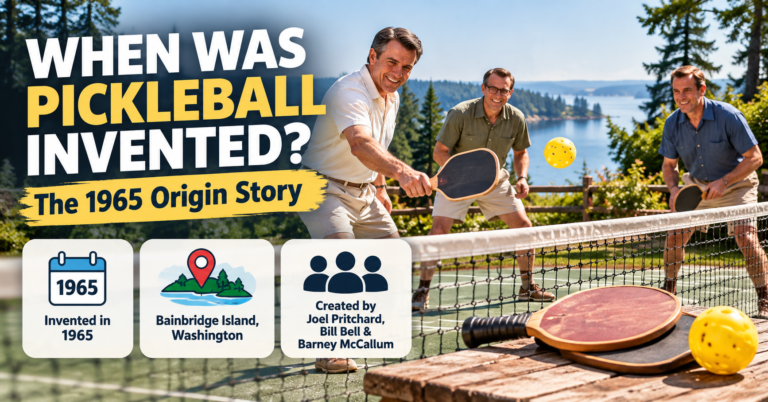
Pickleball was invented in 1965 on Bainbridge Island, Washington, near Seattle, according to The Washington Post. The sport was created…
How Long Is a Pickleball Game? Average Game and Match Times
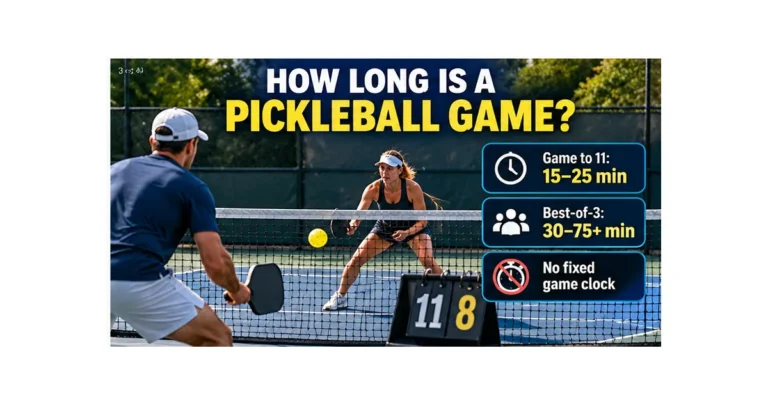
A pickleball game usually lasts 15 to 25 minutes when played to the standard 11 points. There is no fixed…
Is Pickleball Easier Than Tennis? Key Differences Explained
Yes, pickleball is generally easier than tennis for beginners to learn and start playing successfully. Its smaller court, slower-moving ball,…