1-3-1 Full Court Press: Setup, Roles, and How It Actually Works


The 1-3-1 full court press puts one defender on the ball up top, three across the middle, and one back protecting the basket. Its primary purpose is to steer the ball to a sideline and trap it near half court — disrupting tempo and forcing extra passes rather than gambling for steals.
What Is the 1-3-1 Full Court Press?
Picture five defenders spread the length of the floor. One pressures the inbounder’s target. Three sit across the middle band of the court. One stays deep, guarding the rim. As the ball comes in, the top defender angles his body to keep the dribbler pinned to one side, then the nearest wing steps up to trap near the half-court line.
The goal isn’t always the steal. Even when the offense breaks it cleanly, the press has usually eaten clock and broken rhythm. Coaches who run it tend to care less about the highlight steal and more about forcing three or four extra passes per possession — because every extra pass is another chance for the offense to slip up.
One thing worth clearing up: according to Wikipedia, the 1-3-1 zone defense was originally developed to force turnovers through trapping and pestering defense — and the full-court version carries that same DNA, but the rotations aren’t identical to the half-court variant. Same shape on paper. Different responsibilities once the ball starts moving up ninety-four feet.
Positions and Responsibilities
The order you assign these roles matters. Start at the top and work back.
Top Defender
This is the most important spot, so fill it with your most athletic, sideline-to-sideline defender — ideally someone with length who forces high, slow lob passes instead of quick reversals. Coaches with experience running press defenses consistently rank this the hardest position to fill well. His job isn’t to deny the inbounds; it’s to pressure the ball once it’s in and keep it pinned to one side of the floor.
Middle Defender
Quickness over size here. His one rule: keep the ball out of the middle. Offenses live in the middle of the floor against any press, so when he loses that battle, the whole structure tends to unravel. As the trap forms, he slides toward the ball-side sideline to cut off the escape pass.
Wing Defenders
Long players are ideal — length makes sideline passes a nightmare to complete. The wings set the traps near half court and must never concede the sideline in the backcourt. The weak-side wing has a quieter but vital task: when the middle defender rotates toward the ball, the weak-side wing slides in to cover the middle. Teams that skip this step leak easy baskets.
Back Defender
The instinct is to put your tallest player here. That’s the wrong instinct. You want your best rim protector — not just your biggest body. A less mobile player can survive back here since he mostly stays in the paint. The hard rule: he never leaves the lane for a steal unless he’s certain. Guess wrong and it’s a layup.
How the 1-3-1 Full Court Press Is Run, Step by Step
Step 1 — Inbounds and Initial Pressure
As noted by Wikipedia, a full-court press applies defensive pressure across the entire length of the court before and after the inbound pass — and the 1-3-1 version channels that pressure through a specific five-man structure. On the pass in, the top defender immediately gets inside the ball and turns his shoulders parallel to the sideline. That body angle is what steers the ball-handler to one side. The middle defender simultaneously walls off the middle of the floor.
Step 2 — Advancing the Ball Toward the Trap
As the dribbler comes up the floor, the ball-side wing can fake disinterest — retreat a step, look passive — then attack and stop the ball before it crosses half court. He cannot surrender the sideline. The middle defender leaves the middle to deny the long sideline pass, and the weak-side defender rotates in behind to plug the gap.
Step 3 — The First Trap, Near Half Court
The top defender and the ball-side wing converge and trap. Done correctly, the only available pass the offense sees is a reversal — backward, into the backcourt. That’s the entire point. Every forward option is taken away.
Step 4 — Reversal Passes and Re-Trapping
If a reversal goes back, no one chases blindly. Defenders rotate as a unit, because half a second of mistiming leaves someone wide open. Sometimes the offense completes a pass up the sideline into the frontcourt. That doesn’t end the press — it just moves the next trap further up the floor.
Step 5 — The Second, Front-Court Trap
When that sideline pass connects, the closest defender steps in front to stop the ball and seal the sideline while a teammate sprints to finish the trap. The remaining defenders take away reversal options. Anything thrown back into the backcourt is a violation anyway, so there’s no need to guard it.
Strengths of the 1-3-1 Full Court Press
The biggest advantage is tempo control. Teams that want to push the ball and play fast get bogged down — forced to reverse, reset, and burn clock. Because there’s always a basket protector, the top defender can apply real pressure without the usual risk of getting beaten deep. Over a full game, all those forced passes accumulate into live-ball turnovers. Experienced press coaches note the real value shows up late, when a tired offense starts making sloppy decisions under fatigue.
Weaknesses of the Press
No press is free. Bigger, stronger teams can throw over the top of the second line into open frontcourt space and turn the press into their own fast break. The top defender can also wear down quickly if the offense just swings the ball side to side — especially problematic if that defender is also a primary scorer. And structurally, only one player is back. A good rim protector helps, but if two offensive players get downhill after a broken press, the math wins.
1-3-1 Full Court Press vs. Other Common Presses
Here’s how the 1-3-1 compares against the two presses coaches most frequently weigh it against:
| Press | Defenders Back | Primary Aim | Typical Trap Spot | Main Vulnerability |
| 1-3-1 | 1 | Contain tempo, force extra passes | Sideline near half court | Over-the-top pass; lone back defender |
| 2-2-1 | 1 | Slow advancement, contain | Sideline, often past half court | Middle of the floor; quick reversals |
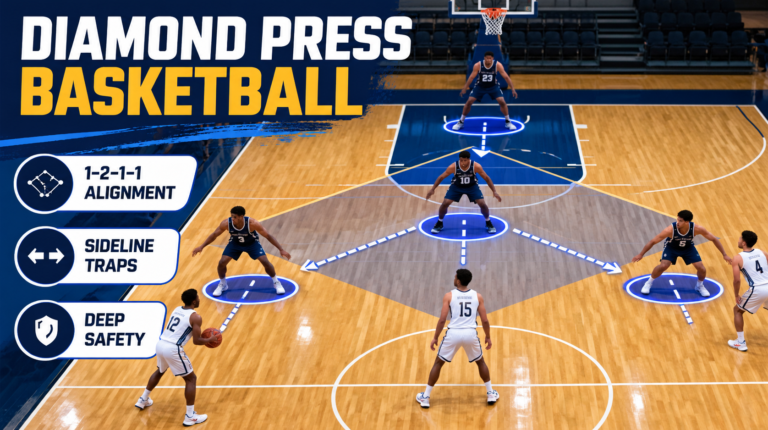
| 1-2-1-1 (Diamond) | 1 | Aggressive trapping for steals | Inbounds and corners | High risk; gives up easy looks if broken |
The pattern most coaches recognize: the 1-3-1 and 2-2-1 lean toward containment, while the diamond press gambles harder for turnovers and accepts more exposure to get them.
Common Variations
The most common adjustment is an aggressive version: everyone starts ten to fifteen feet closer to the ball, and two defenders trap right off the inbounds pass. High risk, high reward — it can generate quick turnovers but leaves more room behind it.
Beyond that, the press has built-in reactions to how the offense tries to escape. Against a backward pass in the backcourt, the top defender closes out and re-steers the new ball-handler. Against a skip pass he can’t reach in time, the middle defender jumps the ball while the top defender sprints across to deny the next sideline option. The shape flexes; the principles hold.
Conclusion
The 1-3-1 full court press is a containment-first defense: steer the ball to a side, trap near half court, and force extra passes. Its trade-off is straightforward — strong tempo control and sustained ball pressure, but only one defender back if the press breaks.
Frequently Asked Questions
Is the 1-3-1 full court press designed to create steals?
Not primarily. It’s a containment press built to disrupt tempo and force extra passes. Turnovers come as a byproduct of those extra passes, not from aggressive gambling.
What type of player should play the top of the 1-3-1 press?
An athletic defender who can cover the floor sideline to sideline. Length is a bonus — taller players force slow lob passes and make quick reversals harder to complete.
What is the biggest weakness of the 1-3-1 full court press?
Having only one defender back. If the offense breaks the front line and gets two players attacking the basket, that lone protector is outnumbered.
How does the full-court 1-3-1 differ from the half-court version?
The shape is the same, but the rotations differ. The full-court version focuses on steering the ball to a sideline and trapping near half court rather than guarding a scoring area.
Can the 1-3-1 press be made more aggressive?
Yes. Defenders start closer to the ball and trap right off the inbounds pass. It produces faster turnovers but leaves more space behind the press if the offense breaks through.

James Carter
ContributorMore from Basketball
Diamond Press Basketball: How the 1-2-1-1 Press Works
Diamond press basketball is a full-court defensive strategy that uses a 1-2-1-1 alignment to pressure the inbound pass, trap the…
How Long Is a College Basketball Game? (2025-26 NCAA Rules)
How long is a college basketball game? Under 2025-26 NCAA rules, regulation remains 40 minutes: men play two 20-minute halves,…

When Is Basketball Season? NBA, College, High School & WNBA Dates
Basketball season usually runs from October or November through March or April, but the exact months depend on the league.…