What Is a Fast Break in Basketball? Explained


A fast break in basketball is a quick offensive push up the court the moment your team gains possession, with one goal: score before the defense gets organized. Speed is everything. Win the ball, push it, finish.
How a Fast Break in Basketball Starts
Most people think a fast break starts on offense. It doesn’t. It starts on defense — the instant your team grabs a rebound or forces a steal, the break is already triggered, according to Wikipedia.
From there, tempo is everything. You want the ball moving up the floor faster than the opposition can backpedal and locate their assignments. Teams that execute the fast break well are already sprinting before the rebound even comes down — that discipline separates average transition teams from elite ones.
The Phases of a Fast Break
Securing Possession
Every fast break begins with a rebound or a steal. No possession, no break. This is also where smart positioning pays off — a guard anticipating a missed shot and drifting toward the outlet spot before the ball is secured can shave half a second off the entire break, which is often the difference between a layup and a contested mid-range.
The Outlet Pass
The outlet pass is the first pass that ignites the break, typically thrown from the rebounder to a guard near the sideline or the middle of the floor. A clean, accurate outlet converts a defensive stop into offense in a heartbeat. Point guards who excel here — think of the way elite playmakers have always prized quick release angles off their own boards — are among the most valuable transition players in the game.
Pushing the Ball Up the Court
Now the runners go. Players sprint wide to fill the lanes while the ball handler attacks the middle. Heads up, eyes forward. This is where conditioning becomes visible — tired legs don’t run lanes properly, and collapsed spacing is what kills a break before it ever reaches the rim.
Finishing the Play
The payoff is a layup or a high-percentage open look. As reported by NBA.com, transition opportunities yield layups and open 3-pointers before the defense is set — making the finish the highest-value moment in the entire sequence. After the shot, roles split immediately: some crash the offensive glass, others rotate back to defend against a potential counter-break. Coaches at every level stress that last rotation because a sloppy finish can hand the other team its own fast break going the other way.
Common Fast Break Situations
Numbers Advantages: 2-on-1 and 3-on-2
The best fast breaks in basketball happen when the offense outnumbers the defense in transition. A 2-on-1 puts two attackers against a single defender; a 3-on-2 puts three against two. These scenarios show up constantly in transition drills because they mirror what actually happens before a defense fully recovers.
When you have more bodies than they do, the lone defender faces an unsolvable choice. Guard the ball and you surrender the pass. Guard the pass and you surrender the layup. That impossible decision is exactly what creates the easy bucket — coaches teach players to force that read, not rush past it.
Why the Fast Break Works
A set defense is difficult to score on. A scrambling one isn’t. The fast break works because it catches defenders mid-recovery: confused about assignments, often mismatched, and physically worn down over the course of a long game. Push the tempo consistently and those defensive breakdowns compound — especially late in games when legs are gone and communication slips.
Keys to Running a Fast Break Well
A few things separate a clean break from a careless turnover. Communicate — nobody reads minds at full sprint. Run hard with your head up so you actually see the floor and your teammates. Spread out wide, because tight spacing lets a single defender cover two players simultaneously. Know your role on the finish: are you shooting, crashing, or getting back? In practice, spacing is almost always the piece that quietly breaks down first.
Fast Break vs. Half-Court Offense
At first glance the two can look similar, but they operate in completely different conditions.
| Aspect | Fast Break | Half-Court Offense |
| When it happens | Right after gaining possession | After the defense is fully set |
| Pace | Fast, urgent | Controlled, deliberate |
| Defense state | Scrambling to recover | Organized and in position |
| Typical goal | Quick layup or open shot | Run a set play for a quality look |
| Spacing role | Run wide, fill the lanes | Set positions and execute screens |
Conclusion
A fast break in basketball is a transition attack that begins the moment you gain possession and aims to score before the defense can organize. Secure the ball, push it fast, fill the lanes, and finish clean — that sequence, executed consistently, is one of the most effective weapons in the sport.
Frequently Asked Questions
What is a fast break in basketball in simple terms?
It’s pushing the ball up the court immediately after a rebound or steal to score quickly, before the other team can set up its defense.
What is an outlet pass in a fast break?
It’s the first pass that starts the break — thrown from the rebounder to a teammate so the ball can move up the floor at speed.
What does a 2-on-1 or 3-on-2 mean in basketball?
They’re numbers advantages in transition: two attackers against one defender, or three against two, before the defense finishes recovering.
Does a fast break start on offense or defense?
It starts on defense. A rebound or steal triggers the break; your team then pushes the other way immediately.
What’s the difference between a fast break and a half-court offense?
A fast break attacks a scrambling, outnumbered defense at speed. A half-court offense runs structured plays against a defense that’s already organized and in position.

James Carter
ContributorMore from Basketball
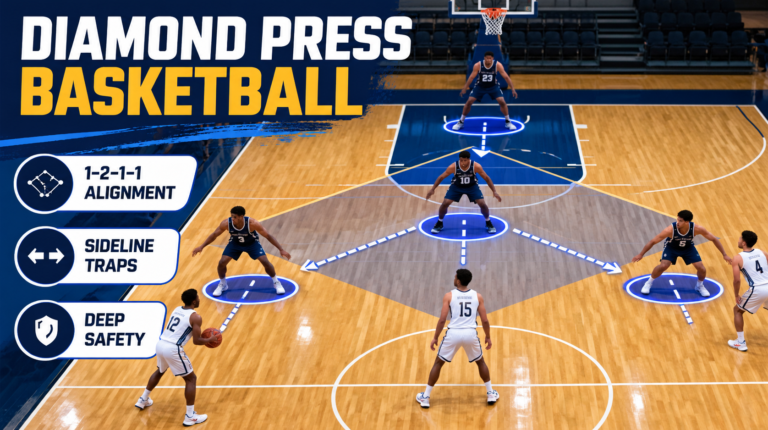
Diamond Press Basketball: How the 1-2-1-1 Press Works
Diamond press basketball is a full-court defensive strategy that uses a 1-2-1-1 alignment to pressure the inbound pass, trap the…
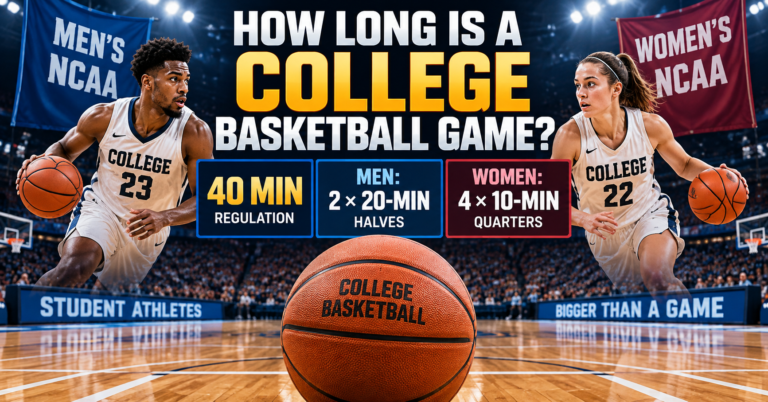
How Long Is a College Basketball Game? (2025-26 NCAA Rules)
How long is a college basketball game? Under 2025-26 NCAA rules, regulation remains 40 minutes: men play two 20-minute halves,…

When Is Basketball Season? NBA, College, High School & WNBA Dates
Basketball season usually runs from October or November through March or April, but the exact months depend on the league.…