How Long Is a Basketball Game? NBA, College, FIBA and High School Times

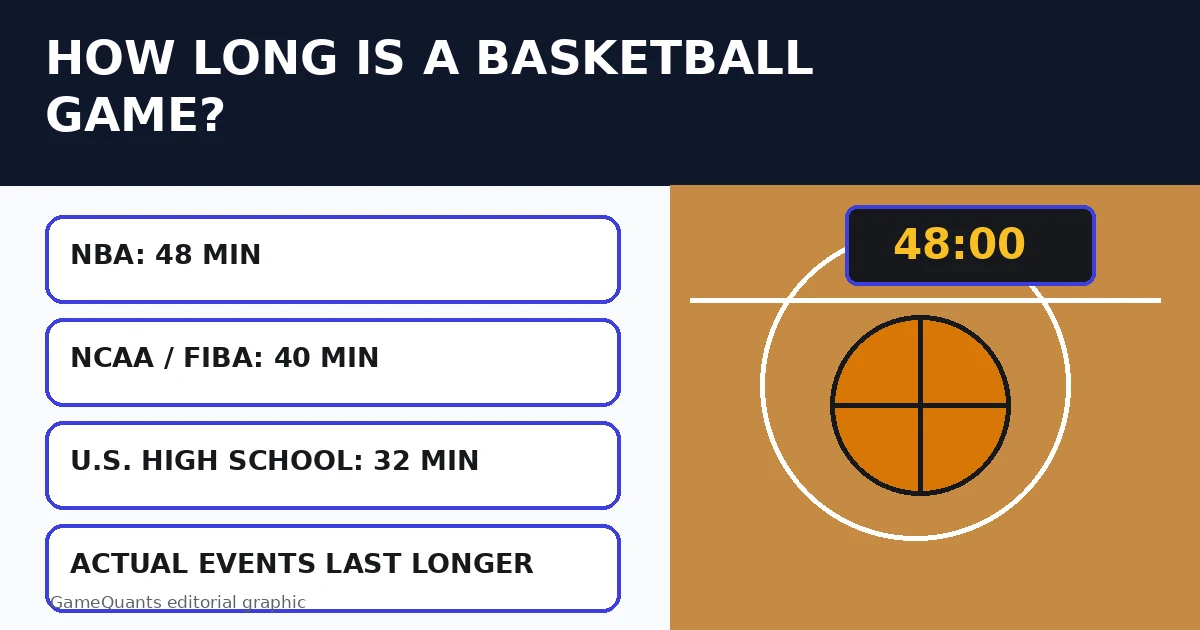
A basketball game is 40 to 48 minutes of regulation playing time, depending on the league. NBA games have 48 minutes on the game clock, while NCAA and FIBA games have 40 minutes. High school games under standard NFHS rules have 32 minutes.
The actual time you spend watching a game is much longer. Timeouts, fouls, halftime, reviews, free throws, and other clock stoppages can push a basketball game well beyond its official playing time.
How long is a basketball game?
The length of a basketball game depends on the competition, according to Wikipedia. The NBA uses longer quarters than FIBA or high school basketball, while NCAA men’s basketball still uses halves.
| Basketball level | Regulation time | Format |
| NBA | 48 minutes | Four 12-minute quarters |
| NCAA men’s | 40 minutes | Two 20-minute halves |
| NCAA women’s | 40 minutes | Four 10-minute quarters |
| FIBA | 40 minutes | Four 10-minute quarters |
| U.S. high school | 32 minutes | Four 8-minute quarters |
These numbers refer to playing time shown on the game clock. They do not tell you how long the entire event lasts from opening tip to the final buzzer.
How long is an NBA game?
An NBA game has 48 minutes of regulation time, divided into four 12-minute quarters, as reported by The Guardian. If the score is tied after the fourth quarter, teams play five-minute overtime periods until a winner is decided.
NBA rules also provide a 15-minute break between halves. Breaks between the first and second quarters and between the third and fourth quarters add more time.
For fans, an NBA game generally requires roughly two to two and a half hours rather than 48 minutes. The difference comes from periods when the game clock is stopped.
NBA games have several sources of stoppage time, including:
- Team and mandatory timeouts
- Free throws
- Fouls and violations
- Out-of-bounds plays
- Replay reviews
- Quarter breaks
- Halftime
- Late-game clock stoppages
NBA rules, for example, stop the clock whenever an official’s whistle sounds and include mandatory timeouts during periods.
How long is college basketball?
College basketball has 40 minutes of regulation playing time, but men’s and women’s NCAA basketball divide those minutes differently.
NCAA men’s basketball uses two 20-minute halves. The format remains in place for the 2026-27 season, although NCAA committees are evaluating a possible future switch to four quarters.
NCAA women’s basketball uses four 10-minute quarters. The NCAA adopted the four-quarter format for women’s basketball beginning with the 2015-16 season.
College games take considerably longer than their 40 minutes of game-clock time. Televised men’s games include media breaks, commonly associated with dead balls around the under-16, under-12, under-8, and under-4-minute marks of each half.
As a result, setting aside about two hours for a college basketball game is a practical estimate, with close games and overtime potentially taking longer.
How long is a FIBA game?
A FIBA basketball game has 40 minutes of regulation play, split into four 10-minute quarters. FIBA also provides a 15-minute halftime interval and two-minute intervals between the first and second quarters and the third and fourth quarters.
If regulation ends in a tie, additional overtime is played to determine the winner.
FIBA is the governing body responsible for the internationally recognized Official Basketball Rules, so this format is common in international basketball competitions played under FIBA rules.
How long is high school basketball?
A standard U.S. high school basketball game under NFHS timing rules has 32 minutes of playing time, divided into four eight-minute quarters. NFHS timing guidance also provides a 10-minute halftime.
That makes the regulation clock shorter than NBA, NCAA, and FIBA basketball.
Actual duration varies by the number of fouls, free throws, timeouts, and other stoppages. Local or state associations may also have specific procedures, so schedules can differ from one competition to another.
Why do basketball games take longer?
The game clock does not run continuously for the full event. A 48-minute NBA game, for example, includes many periods when no game-clock time is being used.
A foul can stop play while officials report the call and players take free throws. Coaches can call timeouts, officials may review certain plays, and scheduled quarter and halftime breaks also add minutes.
The final part of a close game can take especially long. Teams may intentionally foul, call timeouts, and use other late-game strategies that repeatedly stop the clock.
Overtime adds even more time. In the NBA, each overtime period adds five minutes of playing time, plus the stoppages that occur during that period.
Basketball game length FAQs
How long is an NBA game in real time?
An NBA game typically takes roughly two to two and a half hours in real time, even though regulation contains only 48 minutes of playing time. Timeouts, fouls, halftime, reviews, and other stoppages account for much of the difference.
How long is a basketball quarter?
A basketball quarter can be 8, 10, or 12 minutes, depending on the competition. NBA quarters last 12 minutes, FIBA and NCAA women’s quarters last 10 minutes, and standard NFHS high school quarters last eight minutes.
How long is halftime in basketball?
Halftime length varies by league. NBA rules permit 15 minutes between halves, and FIBA rules also specify a 15-minute halftime interval. Standard NFHS high school rules use a 10-minute halftime.
How long is basketball overtime?
NBA overtime lasts five minutes per period. If the game remains tied, another overtime period is played, so there is no fixed maximum length for a tied NBA game.
Final thoughts
So, how long is a basketball game? Regulation ranges from 32 minutes in standard U.S. high school basketball to 48 minutes in the NBA, but the actual event commonly lasts much longer because the clock stops throughout play.

Editorial Team
ContributorMore from Basketball
Diamond Press Basketball: How the 1-2-1-1 Press Works
Diamond press basketball is a full-court defensive strategy that uses a 1-2-1-1 alignment to pressure the inbound pass, trap the…
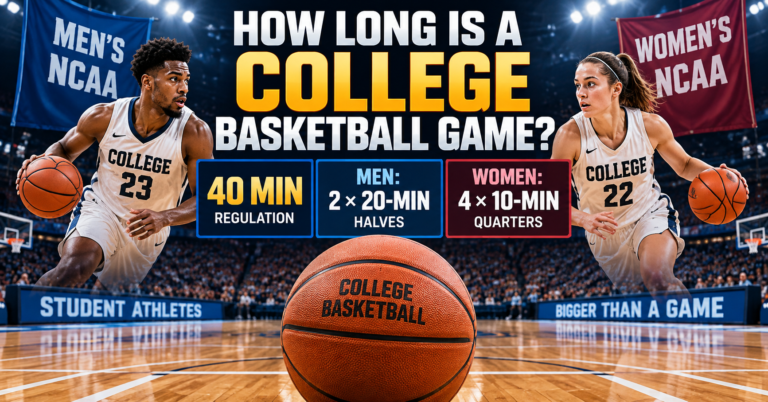
How Long Is a College Basketball Game? (2025-26 NCAA Rules)
How long is a college basketball game? Under 2025-26 NCAA rules, regulation remains 40 minutes: men play two 20-minute halves,…

When Is Basketball Season? NBA, College, High School & WNBA Dates
Basketball season usually runs from October or November through March or April, but the exact months depend on the league.…